How do you become a real estate broker?
To become a real estate broker, you first hold an agent (salesperson) license and build the licensed experience your state requires, usually two to four years. You then complete the state’s broker pre-licensing education, pass the broker exam, and file an application with a background check. The hours, the experience window and even the title vary by state. In Colorado, Illinois, North Carolina and Washington every licensee is already called a broker, so the next license is employing broker, managing broker or broker-in-charge.

Key takeaways
- The steps are the same in every state: agent license, experience, broker education, exam, application.
- In the eleven states below, experience ranges from 2 to 4 years and broker education from 12 hours (North Carolina) to 900 hours (Texas).
- In Colorado, Illinois, North Carolina and Washington, “broker” is the first license. Look for the supervising license instead.
- Getting the license and opening a brokerage are separate decisions. Opening a firm adds a trust account, supervision duties and a compliance process.
Agent, broker, managing broker: what the titles mean
An agent (called a salesperson in California and New York) is licensed to help clients buy and sell, but only under a broker’s supervision. A broker holds a higher license that allows them to work independently, hold client funds and supervise agents. Every brokerage firm has at least one broker responsible for it. Depending on the state, that person is called the designated, managing or employing broker, and they answer to the regulator for what the firm’s agents do.
“Becoming a broker” can mean two different things: earning the broker license, and later taking responsibility for a firm. This guide covers both.
The five steps, in order
- Start
Get licensed as an agent
Complete your state’s pre-licensing course, pass the salesperson exam and join a brokerage. The experience requirement is counted from the date you are licensed.
- 2 to 4 years
Build the licensed experience
Most states count full-time licensed activity within a recent window: two years within five in California, four within five in Texas. New York and Texas also measure experience in points.
- Months
Complete broker education
Broker-level courses in brokerage management, law, finance and appraisal. In this guide’s states the hours range from 12 (North Carolina) to 900 (Texas, where a bachelor’s degree covers 630 of them).
- Weeks
Pass the broker exam
A state exam, often with a national portion, focused more on management and law than the agent exam.
- Weeks
Apply and activate
File with the regulator, complete the background check and fingerprinting, and activate the license under a firm, either your own or another broker’s.
Requirements in 11 states
The table covers the eleven states SkySlope publishes state guides for. Each state name links to that guide, and each row links to the rule it was taken from. Requirements change, so treat the regulator’s page as the final word.
| State | What you apply for | Experience | Education | Also required |
|---|---|---|---|---|
| California | Real estate broker | 2 years full-time as a licensed salesperson within the last 5 years; or 2 years of equivalent experience; or a 4-year degree with a real estate major or minor | 8 college-level courses of at least 45 hours each: Real Estate Practice, Legal Aspects, Finance, Appraisal, Economics or Accounting, plus 3 electives | Age 18 or older; state examSource |
| Texas | Broker | 4 years of active experience in the 5 years before applying, plus the experience points TREC requires | 900 hours: 270 qualifying real estate hours and 630 related hours (a bachelor’s degree satisfies the 630) | State exam. TREC’s advisory committee has proposed changes to the experience points, so confirm the current figure with TRECSource |
| Florida | Broker | 24 months active as a sales associate within the past 5 years | 72-hour broker pre-license course, with at least 70% on the end-of-course exam | State exam score of 75% or higher; 60 hours of post-licensing education in the first renewal cycleSource |
| New York | Real estate broker | 2 years as a licensed salesperson, 3 years in the general real estate field, or a combination, meeting the Department of State’s experience points | 152 hours of qualifying education (the 77-hour salesperson course and the 75-hour broker course) | Age 20 or older; a 2.5-hour multiple-choice state examSource |
| Colorado | Employing broker (every licensee is a broker) | 2 years of active broker experience | 24 hours of Brokerage Administration | Background check; national and state portions of the broker examSource |
| Arizona | Broker (a designated broker runs the firm) | 3 years of active licensed experience within the last 5 years | 90-hour broker pre-licensing course | Broker exam; a 9-hour Broker Management Clinic before activationSource |
| Georgia | Broker or associate broker | Licensed on active status for 3 of the previous 5 years | 60-hour broker pre-license course | Age 21 or older; broker examSource |
| Illinois | Managing broker (every licensee is a broker) | An active real estate license for 2 of the past 3 years | 45 hours: 30 hours of topics and 15 hours of applied management and supervision | Age 20 or older; managing broker examSource |
| North Carolina | Broker-in-charge (every licensee is a broker) | 2 years full-time or 4 years part-time brokerage experience within the previous 5 years | 12-hour Broker-in-Charge Course | A full (not provisional) broker license on active statusSource |
| Virginia | Broker | Actively engaged full-time for 36 of the 48 months before applying | 180 hours: a Brokerage course plus three broker-specific courses, or two plus one broker-related course | State and national broker examSource |
| Washington | Managing broker (every licensee is a broker) | 3 years full-time as a broker within the last 5 years | 90 hours within 3 years: brokerage management, business management and advanced real estate law, 30 hours each | Managing broker examSource |
The Florida and Arizona rows cite the state REALTOR® association’s summary of the regulator’s rule. The Georgia row is consistent across several sources but could not be read on the regulator’s own site; confirm it with the Georgia Real Estate Commission. Every other row cites the regulator directly.
States where every licensee is a broker
In Colorado, Illinois, North Carolina and Washington, the first license a new licensee receives is already called a broker. The next step is the license or designation that lets a broker run or supervise a firm:
- Colorado: an employing broker license, after two years of active broker experience and 24 hours of Brokerage Administration.
- Illinois: a managing broker license, after two of the past three years licensed and 45 hours of education.
- North Carolina: broker-in-charge eligibility, after two years full-time (or four part-time) and a 12-hour course.
- Washington: a managing broker license, after three years full-time and 90 hours of education.
If you are licensed in one of these states, look up the requirements under the supervising title.
Associate broker or your own brokerage?
A broker license gives you options. You still decide whether to run a firm.
| Associate broker | Your own brokerage | |
|---|---|---|
| Who supervises you | Another broker, who is responsible for the firm | You, for yourself and every agent you hire |
| Client money | Held in the firm’s trust account | Held in a trust account you open and reconcile |
| Income | Your own commissions, usually on a better split | Your commissions plus the firm’s share of every agent’s commissions and fees |
| Costs | Your usual agent costs | Office, insurance, licensing the firm, technology and staff |
| Time | Mostly selling | Less selling; more recruiting, file review and financial management |
What it takes to open a brokerage
Opening a brokerage means the firm must meet the regulator’s requirements from its first transaction. Each of the following is easier to set up before you start than to fix after an audit.
License the firm as well as yourself
Many states license the brokerage entity, such as a corporation or LLC, separately from the broker and require a qualifying broker to be named as responsible for it. Form the entity first, then license it.
Open a trust account before you take a deposit
Earnest money and other client funds go into a trust or escrow account and must not mix with the firm’s operating money. California, for example, limits a broker’s own money in a trust account to $200 for bank charges and requires earned commissions deposited there to be withdrawn within 25 days. How brokerage software keeps these funds separate is covered in our guide to real estate accounting software for brokerages.
Deposit timing is also regulated. California requires trust funds to reach the trust account, a neutral escrow or the owner within three business days of receipt by the broker or agent. Seven of the ten violations the California DRE lists as most common in broker audits concern trust funds.
Write the agent agreement and the policy manual
Agents are usually independent contractors. For federal tax purposes, a licensed agent who is paid on sales output under a written agreement stating they are not an employee is a statutory non-employee, so the agreement matters. The policy manual sets out how the firm handles offers, disclosures, advertising and client funds.
Decide how you will supervise files
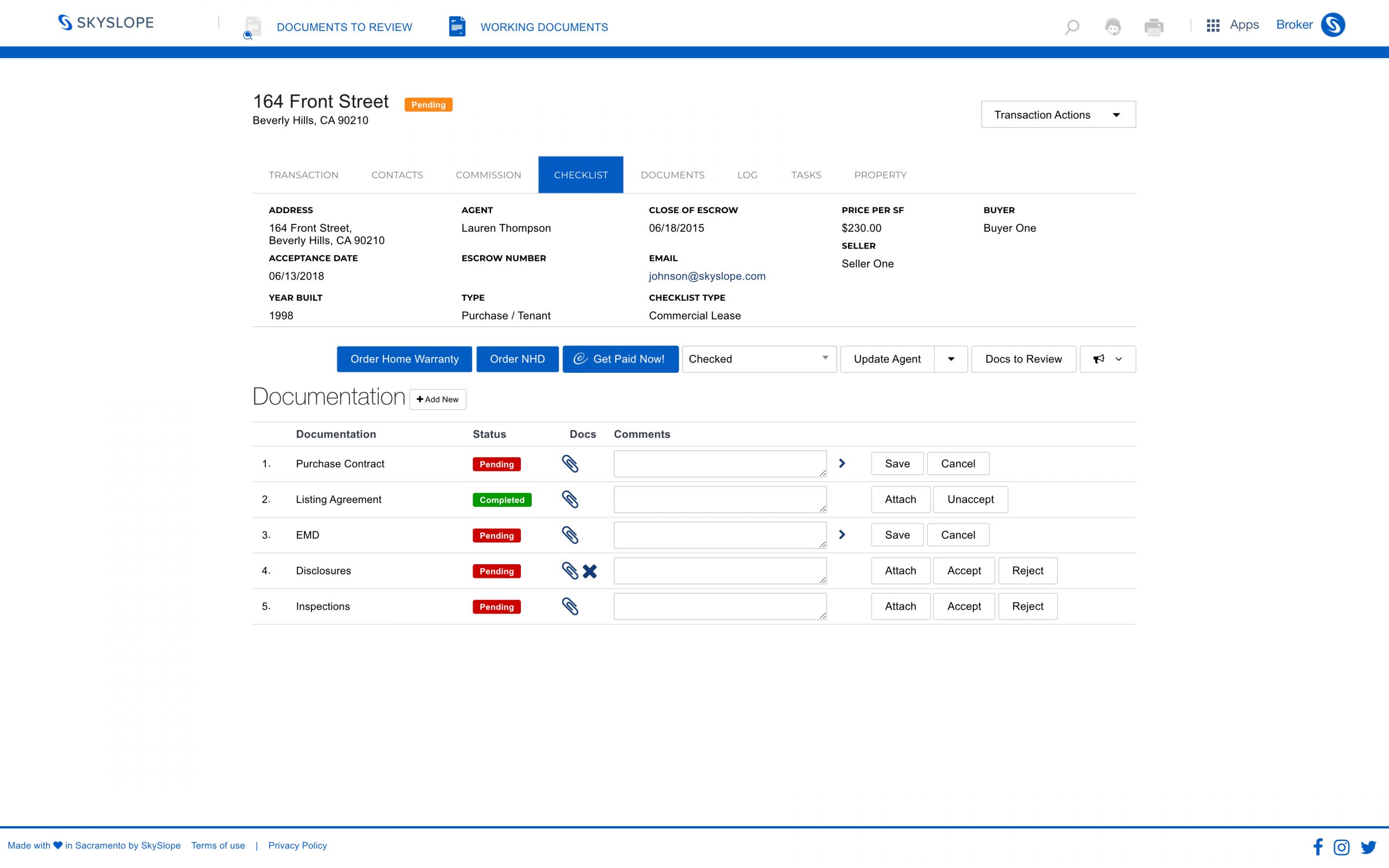
A broker is responsible for every file the firm’s agents open. That requires a checklist for each transaction type, someone who reviews documents before closing, and a record of what was approved. These are core features of real estate transaction management software, and our article on small-brokerage compliance explains how a small office handles review without an extra hire.
Put your license number where the regulator expects it
Two of the California DRE’s ten most common audit findings concern identification rather than money: license numbers missing from first-contact materials such as business cards, websites and purchase agreements, and business names that are not on the license. Both are simple to fix before the first listing.
Set up commissions and agent billing
Each closing is split between the agent, the brokerage and sometimes a franchise or team, and agents are billed fees every month. A spreadsheet can manage this for a few agents but becomes unreliable once caps and team splits are involved. Our guide to real estate back office software covers this in detail.
Choose your software
A new brokerage needs forms, e-signature, transaction management with compliance review, and accounting, and those systems work best when they share data so each deal is entered once. SkySlope Suite covers transaction management and forms, with DigiSign and SkySlope Books available as add-ons. Suite pricing starts at $340 per month, with no long-term contract required.
Is it worth it?
The U.S. Bureau of Labor Statistics reports a median annual wage of $73,220 for real estate brokers in May 2025, compared with $52,830 for sales agents, and counts about 103,500 broker jobs. Individual results vary widely. A broker who continues selling under another firm earns on their own deals, while a brokerage owner earns on the firm’s margin across all its agents after the costs of running it.
The license is most useful for agents who want a better split, want to supervise others, or plan to open a firm. For agents who want to keep selling and are not interested in management, the extra education and responsibility may not add much income.
FAQ
How long does it take to become a real estate broker?
Mostly as long as the experience requirement. The states in this guide ask for two to four years as a licensed agent within a recent window (two in California and Florida, three in Arizona and Georgia, four in Texas). The broker course and exam usually add a few months.
Can you become a broker without being an agent first?
In most states, no. The experience has to be as a licensed agent. A few states allow alternatives: California accepts two years of equivalent experience or a four-year degree with a real estate major or minor, and New York counts three years in the general real estate field.
What is the difference between a broker and a Realtor?
Broker is a license issued by the state. REALTOR® is a trademark for members of the National Association of REALTORS®, who agree to its Code of Ethics. An agent or a broker can be a REALTOR®, but the two credentials are separate.
Do I have to open my own brokerage once I’m a broker?
No. Many brokers keep working under another firm as an associate broker. The broker license allows you to run a firm, supervise agents and hold client funds. It does not require you to.
What is an associate broker?
A licensed broker who works under another broker’s firm instead of running their own. Georgia issues a separate associate broker license. In other states it is a role, not a separate license.
How much do real estate brokers earn?
The U.S. Bureau of Labor Statistics reports a median annual wage of $73,220 for real estate brokers in May 2025, compared with $52,830 for sales agents. A brokerage owner’s income also depends on the firm’s agent count, splits and costs.
Opening a brokerage? See how SkySlope handles forms, signatures, compliance review and commissions from the first file.
Request a demo →Sources
- California broker requirements. www.dre.ca.gov/examinees/requirementsbroker.html
- Texas broker requirements. www.trec.texas.gov/node/2810
- Florida broker requirements. www.floridarealtors.org/education/broker-licensing
- New York broker requirements. dos.ny.gov/become-real-estate-broker
- Colorado broker requirements. dre.colorado.gov/division-programs/real-estate-broker/licensing/broker-license-application-requirements
- Arizona broker requirements. www.aaronline.com/brokers/broker-license-requirements/
- Georgia broker requirements. grec.state.ga.us/licensed-professionals/education-requirements/real-estate/
- Illinois broker requirements. idfpr.illinois.gov/profs/realest.html
- North Carolina broker requirements. www.ncrec.gov/BICEligibleReqAndDesignation
- Virginia broker requirements. www.dpor.virginia.gov/Boards/Real-Estate/Pre-License
- Washington broker requirements. dol.wa.gov/professional-licenses/real-estate-managing-brokers/get-your-license-real-estate-managing-broker
- U.S. Bureau of Labor Statistics, Real Estate Brokers and Sales Agents. www.bls.gov/ooh/sales/real-estate-brokers-and-sales-agents.htm
- California Code of Regulations, title 10, section 2835 (commingling). www.law.cornell.edu/regulations/california/10-CCR-2835
- California DRE, Ten Most Common Violations Found in DRE Audits. dre.ca.gov/files/pdf/CommonViolationsFoundInAudits.pdf
- 26 U.S.C. section 3508, treatment of real estate agents. www.law.cornell.edu/uscode/text/26/3508


SkySlope Launches Ayce to Help Real Estate Agents Translate Goals Into Higher Income Faster
SkySlope’s real estate coach helps agents stay on track and...
How to Build a Resilient Real Estate Business (Especially When the Market’s Not Cooperating)
Interest rates are high. Buyers are nervous. Sellers are hesitant....
What’s New in Books: Easier Deal Setup, Exports and More
What’s New in Deal Setup More Control Over Commission Payers...
Brokers Can’t Control the Market, But They Can Control Their Spend
As seen in RISMedia: This article originally appeared in RISMedia,...
Automate the Busywork with SkySlope’s Newest Features
Catch the latest from SkySlope. Introducing smart solutions and updates...
Best Real Estate Transaction Management Software in 2026
The short answer What is real estate transaction management software?...
Unlocking the Power of Your Data: SkySlope’s Open API Ecosystem
For more than a decade, SkySlope has been the trusted...
Transaction Coordinator Software for Real Estate: What TCs Need and What the Rules Allow
The short answer What is transaction coordinator software? Transaction coordinator...
The Real 2026 Agent Report Card, Straight From the Transaction Data
How Many Transactions Did the Average Real Estate Agent Close...
9 Out Of 10 SkySlope Agents Agree: Web Calculations Are A Game-Changer
You saw us add Seller Net Sheets. Then we followed...