What does AI do in real estate transaction management?
AI in real estate transaction management handles the paperwork around a deal: it recognizes the documents in an upload, splits and files them, pulls dates, prices and parties out of the contract, flags missing signatures and mismatched data for the compliance reviewer, and drafts summaries and emails. The decisions stay with licensed people. California’s Department of Real Estate said in March 2026 that when an AI tool gets something wrong, responsibility rests with the licensee and the responsible broker, not the technology provider.
SkySlope builds these features into the transaction file as its Smart Suite, including Auto-Split & Assign for uploaded PDFs and Smart Assist for auditors’ file reviews.
Key takeaways
- AI in transaction software does clerical and review-support work: filing documents, extracting contract data, flagging missing signatures and drafting.
- Licensees answer for what their AI tools produce: under South Carolina’s license law since May 2024, and with their brokers under California’s March 2026 guidance.
- Colorado replaced its 2024 AI Act in May 2026. The new law covers decisions such as leasing or buying a Colorado home from January 1, 2027.
- HUD withdrew its 2024 guidance on AI and digital housing ads. The Fair Housing Act’s ban on discriminatory ads did not change.
- Since January 1, 2026, California requires a disclosure and a link to the original on digitally altered listing photos, AI edits included.
What AI does in a real estate transaction today
How is AI used in real estate transactions?
California’s Department of Real Estate (DRE) lists “supporting transaction and document review” among the common uses of AI in real estate: summarizing documents, tracking deadlines and identifying potential errors or non-compliance. Inside transaction software that work breaks into five jobs:
- Recognizing documents: telling which pages of an upload are the purchase agreement, the agency disclosure or an addendum.
- Splitting and naming: breaking a scanned packet into documents and filing each against the right checklist item.
- Extracting data: pulling the price, key dates and the buyers’ and sellers’ names from the contract into the file.
- Review assistance: flagging missing signatures and initials, and data that does not match across documents or the MLS, for the compliance reviewer.
- Drafting: summaries, client emails and listing copy. NAR’s October 2026 broker guidance calls listing descriptions and emails repeatable work AI does well.
What is AI document processing in real estate?
AI document processing is the first three jobs together: the software works out what each document is, files it and extracts the data the file needs. It replaces typing; the review stays with people. In Texas, an unlicensed assistant may enter data into a contract only as a license holder specifically directs, and may not review a contract at all. And every job can be wrong in a way that looks right: in NAR’s words, AI “sounds confident even when it is wrong.” A misread contingency date becomes a missed deadline, so check extracted dates first.
What a person must still decide
Can AI handle real estate compliance review?
AI can prepare the compliance review. License law puts the review itself on the broker, and regulators have started to say in writing that this covers AI tools.
- California. Regulation 2725 requires a responsible broker to keep systems to review, oversee, inspect and manage licensed transactions, documents that may have a material effect on a party’s rights or obligations, and how those documents are filed and stored; others may help, but the broker keeps overall responsibility. The DRE’s March 17, 2026 advisory adds that “a broker’s supervisory obligation extends to the tools used to conduct licensed or unlicensed activities, including AI-powered software,” and that AI output should be reviewed and approved by the licensee before anyone relies on it.
- South Carolina. Under S.C. Code 40-57-820, in force since May 21, 2024, a licensee “is responsible for any and all work product produced by him or with the assistance of artificial intelligence,” and a violation committed through AI is treated as the licensee’s own.
- REALTORS everywhere. Articles 2 and 12 of NAR’s Code of Ethics bar exaggeration, misrepresentation or concealment of pertinent facts and require a true picture in advertising. NAR’s AI policy kit, as NAR’s October 2026 guidance quotes it, says “fully autonomous execution without human review is prohibited.”
So a person still decides whether each document is right, whether each date matches the signed contract, whether a flagged signature is really missing, what the contract means and whether anything sent out is accurate. The DRE also recommends keeping records of how AI output was reviewed. Our guide to compliance for small brokerages covers how to set up the review itself.
Task by task: what AI does, who decides, which rule applies
Which real estate tasks can AI do?
Nine tasks AI now touches, from the upload to the ad: what the software can do, the decision that stays with a person, and the rule that keeps it there.
Recognizes each document in a PDF, splits the packet and files each one against a checklist item.
Confirm each document sits on the right item. The broker’s system covers how documents are filed and stored.
Reads the price, key dates and the buyers’ and sellers’ names into the file.
Check each date against the signed contract and every counteroffer. In Texas, an unlicensed person enters contract data only as a license holder directs.
Flags missing signatures and initials and marks documents that appear complete.
Accept or reject each document. The licensee answers for work produced with AI; the broker keeps overall responsibility.
Cross-checks the address and MLS number across forms, the file and the MLS entry.
Decide which record is right and correct the other. REALTORS must not misrepresent pertinent facts.
Summarizes a contract or an addendum.
A licensee reviews the contract. In California, explaining legal rights beyond the license can be the unauthorized practice of law.
Drafts client emails, listing descriptions and posts.
Verify every fact, describe the property and not the people, and keep license and broker identification on first-contact ads in California.
Stages a room or changes elements in a photo.
In California since January 1, 2026: label the altered image and link to the original.
Writes reviews or testimonials on request.
Publish only real clients’ reviews of their real experience.
Scores, ranks or recommends renters or buyers.
In Colorado from January 1, 2027: notice, an explanation within 30 days of an adverse decision, human review on request. Fair housing law applies everywhere.
The rules that apply to AI in a brokerage
What laws apply to AI in real estate?
Congress has not passed a federal AI framework; NAR asked it to in August 2026. Until it does, the rules are the existing ones, which regulators apply to AI, plus a few state laws written for it.
| Rule | Who it binds | What it requires | Status, November 2026 |
|---|---|---|---|
| FTC Act, Section 5 | Anyone who advertises, AI vendors included | Claims about what AI does, including accuracy, must be true and backed by competent and reliable evidence | In force; the FTC said in December 2025 it will keep acting against AI deception |
| FTC reviews rule, 16 CFR 465 | Businesses | No reviews from people who do not exist or had no real experience; the FTC named AI-generated fake reviews | Final rule announced August 14, 2024 |
| Fair Housing Act, 42 U.S.C. 3604(c) | Anyone who publishes a housing ad | No ad may indicate a preference, limitation or discrimination based on a protected class | In force; HUD’s 2024 digital-ad guidance withdrawn |
| Colorado SB 26-189 | Businesses that use or build automated decision tools, including for leasing or buying a home in Colorado | Notice before use; an explanation within 30 days of an adverse decision; correction and human review on request; three years of records | From January 1, 2027 |
| California Bus. & Prof. Code 10140.8 | Brokers, salespersons and people acting for them | A disclosure on a digitally altered listing image, AI edits included, and a link or QR code to the original | Since January 1, 2026 |
| South Carolina Code 40-57-820 | Licensees | The licensee answers for work product made with AI | Since May 21, 2024 |
Read at each source on November 3, 2026.
Did HUD withdraw its AI guidance?
Partly. In May 2024 HUD released two AI guidance documents, on tenant screening and on housing ads through digital platforms. A Federal Register notice of April 6, 2026 withdrew the advertising guidance, effective September 17, 2025, with seven other documents. The tenant screening guidance is not on that list or on HUD’s July 17, 2026 list. The statute did not move: the notice says actions that do not comply with the text of the Fair Housing Act remain subject to enforcement, and private suits can still be filed within two years. NAR’s advice for AI copy: focus on the property’s features, not the people you think should live there.
When does Colorado’s AI law take effect?
January 1, 2027, in a different form from the law most articles describe. The 2024 AI Act (SB 24-205) was due to apply from February 1, 2026; a special session moved that to June 30, 2026 (SB 25B-004); and SB 26-189, signed May 14, 2026, replaced it before it took effect. The new law covers automated decision-making technology that materially influences a consequential decision, including the lease or purchase of residential real estate in Colorado. It excludes tools used solely to summarize, organize, translate, draft, route or present information for human review, and it excludes advertising, marketing and workflow management. Only the attorney general enforces it, and until 2030 must first offer 60 days to cure where a cure is possible.
A December 2025 executive order (14365) directs the U.S. Attorney General to form a task force to challenge state AI laws, citing Colorado’s 2024 law. Watch for court action before treating either as settled.
Can AI be a transaction coordinator?
Can AI replace a transaction coordinator?
AI can take on the clerical part of a transaction coordinator’s job: intake, filing, data entry, reminders and drafts. The licensed part stays with people, and the line is drawn by the rules that already apply to unlicensed assistants.
- California. The DRE warns that using AI tools to conduct licensed activity “may be equivalent to asking an unlicensed assistant to do licensed activity, which is a violation of California real estate law.”
- Texas. An unlicensed assistant may not review a contract or facilitate a transaction. TREC’s Broker Responsibility Advisory Committee discussed AI on July 14, 2026 and tabled its transaction coordinator topic until the next meeting.
- NAR. Its AI policy kit says AI may not carry out activities requiring a real estate license or create obligations on a brokerage’s behalf.
Our guide to transaction coordinator software covers what a TC needs from the software and what each state lets an unlicensed TC do.
Questions to ask before you turn on an AI feature
How should a brokerage evaluate AI in transaction software?
- Does it flag or decide? A feature that flags items for a reviewer fits the rules above; one that approves on its own needs a written answer on who checks it.
- What evidence backs the claim? The FTC requires accuracy claims to rest on competent and reliable evidence; in 2025 it acted against an AI detector advertised as 98% accurate that tested at 53% on general content. Ask the vendor what was measured, on which documents.
- Where does client data go? NAR’s template allows only approved tools for client, transaction or brokerage data. South Carolina’s commission recommends that licensees put no client personal information into an AI program and get the client’s written permission before using AI on their work.
- Is there a record? The DRE recommends keeping records of how AI output was reviewed. For covered decisions, Colorado will require three years of records.
- Is it in your policy? The DRE says brokers should adopt written AI policies and train licensees on them.
The rest of the evaluation, from checklists to reporting, is in our guide to transaction management software.
AI in SkySlope
SkySlope groups its AI features as the Smart Suite. In SkySlope’s own words:
- Auto-Split & Assign: agents upload a PDF and it scans, splits and routes the documents to the right checklist items.
- Smart Assist: built for auditors, it detects completed signatures and initials, highlights what appears ready for approval and suggests possible compliance issues. SkySlope describes it cross-referencing MLS data against transaction files and flagging inconsistencies before a file is approved.
- Smart Scan: for Stellar MLS and realMLS members, it extracts key details from purchase contracts into agents’ workflows.
- Smart Listings: when a listing agreement is signed in SkySlope Forms, it creates the SkySlope file and adds the agreement.
- Smart Blocks and Smart Emails: signing blocks placed where signatures are required, and suggested messages for documents sent for signature.
- Voice Offers & Agreements: offers and agreements started by voice, currently in California and North Carolina.
- SkySight and Ayce: a weekly AI-powered podcast of a brokerage’s key stats for brokers, and AI-powered coaching for agents.
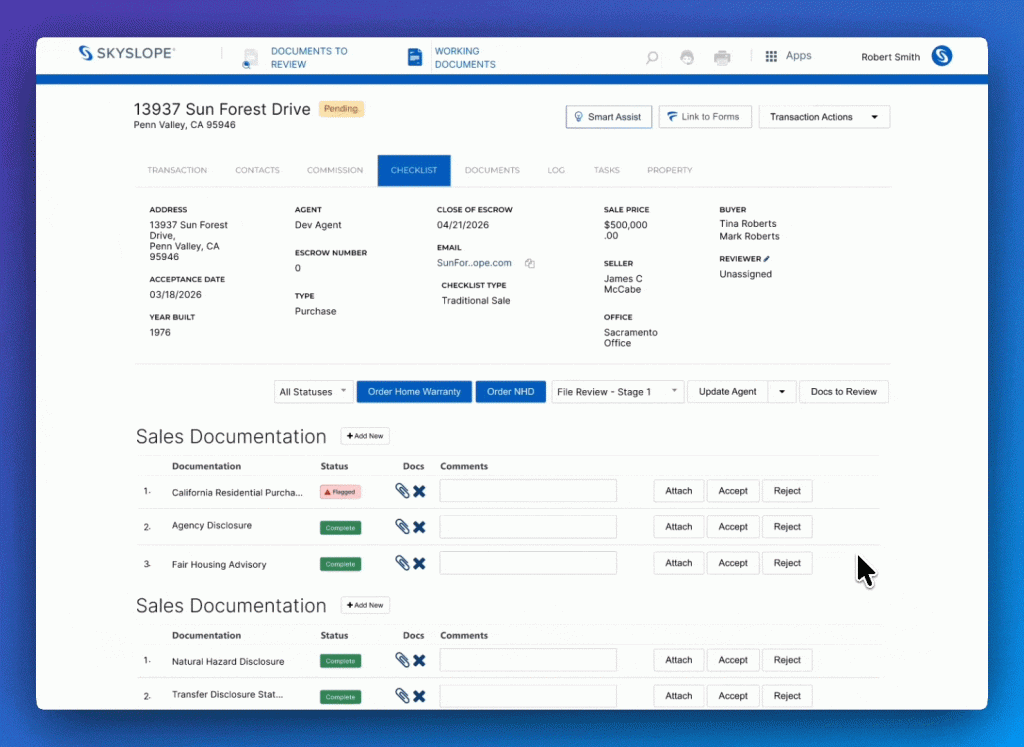
Auto-Split & Assign, Smart Assist and Smart Listings work on the SkySlope transaction file and its checklist, where the broker’s review already happens.
FAQ
Can AI help manage real estate transactions?
Yes, with the paperwork. AI in transaction software can split and file uploaded documents, extract dates, prices and parties from a contract, flag missing signatures and mismatched data, and draft summaries and emails. California’s Department of Real Estate says the licensee should review and approve AI output before anyone relies on it.
Who is responsible when AI makes a mistake in a real estate transaction?
The licensee and the responsible broker. California’s Department of Real Estate said in March 2026 that responsibility rests with them, not the technology provider. South Carolina’s license law, S.C. Code 40-57-820, treats a violation committed through AI as the licensee’s own.
Did HUD withdraw its guidance on AI and fair housing?
Partly. A notice published April 6, 2026 withdrew HUD’s 2024 guidance on housing ads through digital platforms, effective September 17, 2025. The 2024 tenant screening guidance is not on that list or on HUD’s July 2026 list. The Fair Housing Act itself did not change.
When does Colorado’s AI law take effect?
January 1, 2027. SB 26-189, signed May 14, 2026, replaced the 2024 Colorado AI Act before it took effect and covers consequential decisions, including leasing or buying a home in Colorado. Tools used only to summarize, organize, draft or route information for human review are excluded.
Can AI review a real estate contract?
It can summarize a contract and flag missing items, but a licensee has to review it. In Texas an unlicensed assistant may not review a contract, and California’s Department of Real Estate warns that using AI for licensed activity may be equivalent to having an unlicensed assistant do it.
What is SkySlope AI?
SkySlope groups its AI features as the Smart Suite: Auto-Split & Assign, which splits uploaded PDFs and routes documents to checklist items; Smart Assist, which detects signatures and initials and suggests possible compliance issues for auditors; Smart Scan; Smart Listings; Smart Blocks; Smart Emails; Voice Offers & Agreements; SkySight; and Ayce.
See how Smart Suite features fit your brokerage’s review process.
Request a demo →Sources
- California DRE, Artificial Intelligence in California Real Estate, licensee advisory (March 17, 2026). dre.ca.gov/Licensees/Advisories/Advisory_2026_03_17_AI_in_California_Real_Estate.html
- California Code of Regulations, title 10, section 2725 (broker supervision). www.law.cornell.edu/regulations/california/10-CCR-2725
- California Business and Professions Code 10140.8 (digitally altered images). leginfo.legislature.ca.gov/faces/codes_displaySection.xhtml?lawCode=BPC§ionNum=10140.8
- South Carolina Code, title 40, chapter 57 (section 40-57-820). www.scstatehouse.gov/code/t40c057.php
- South Carolina Real Estate Commission, Use of Artificial Intelligence in Real Estate Practice (June 12, 2025). llr.sc.gov/re/News/AI%20Use.pdf
- TREC, Can you use unlicensed individuals to help your Texas real estate transactions?. www.trec.texas.gov/article/can-you-use-unlicensed-individuals-help-your-texas-real-estate-transactions-it-depends
- TREC, BRAC discusses inactive license education, AI and industry transparency (July 2026). www.trec.texas.gov/article/brac-discusses-inactive-license-education-ai-and-industry-transparency
- Colorado General Assembly, SB 26-189, Automated Decision-Making Technology. leg.colorado.gov/bills/sb26-189
- Colorado SB 26-189, signed act (May 14, 2026). leg.colorado.gov/bill_files/116489/download
- Colorado General Assembly, SB 25B-004. leg.colorado.gov/bills/sb25b-004
- Colorado General Assembly, SB 24-205. leg.colorado.gov/bills/sb24-205
- Executive Order 14365, Ensuring a National Policy Framework for Artificial Intelligence (90 FR 58499). www.govinfo.gov/content/pkg/FR-2025-12-16/pdf/2025-23092.pdf
- HUD, Notification of Withdrawal of Fair Housing and Equal Opportunity Guidance Documents (91 FR 17291, April 6, 2026). www.govinfo.gov/content/pkg/FR-2026-04-06/pdf/2026-06624.pdf
- HUD, Notice of the Withdrawal of OGC Guidance Documents (91 FR 44867, July 17, 2026). www.govinfo.gov/content/pkg/FR-2026-07-17/pdf/2026-14432.pdf
- HUD, Fair Housing Act guidance on applications of artificial intelligence (press release, May 2, 2024). archives.hud.gov/news/2024/pr24-098.cfm
- 42 U.S. Code 3604, discriminatory housing advertising. www.law.cornell.edu/uscode/text/42/3604
- FTC, Order requires Workado to back up artificial intelligence detection claims (April 28, 2025). www.ftc.gov/news-events/news/press-releases/2025/04/ftc-order-requires-workado-back-artificial-intelligence-detection-claims
- FTC, Final order against Workado (August 28, 2025). www.ftc.gov/news-events/news/press-releases/2025/08/ftc-approves-final-order-against-workado-llc-which-misrepresented-accuracy-its-artificial
- FTC, Reopens and sets aside Rytr final order (December 22, 2025). www.ftc.gov/news-events/news/press-releases/2025/12/ftc-reopens-sets-aside-rytr-final-order-response-trump-administrations-ai-action-plan
- FTC, Final rule banning fake reviews and testimonials (August 14, 2024). www.ftc.gov/news-events/news/press-releases/2024/08/federal-trade-commission-announces-final-rule-banning-fake-reviews-testimonials
- 16 CFR 465.2, fake or false consumer reviews and testimonials. www.law.cornell.edu/cfr/text/16/465.2
- NAR, 2026 Code of Ethics and Standards of Practice. www.nar.realtor/sites/default/files/2025-12/2026-COE-Standards-of-Practice-2026-01-01.pdf
- NAR, Faster, Cheaper, Riskier? What Brokers Should Know Before Putting AI to Work (October 23, 2026). www.nar.realtor/news/real-estate-news/technology/faster-cheaper-riskier-what-brokers-should-know-before-putting-ai-to-work
- NAR, Artificial Intelligence (AI) in Real Estate. www.nar.realtor/artificial-intelligence-real-estate
- SkySlope, Smart Suite. skyslope.com/smart-suite/
- SkySlope, Beyond the AI hype (June 2026). skyslope.com/general/beyond-the-ai-hype-how-skyslope-delivered-a-year-of-real-innovation/

