How does fair housing law apply when a seller reviews offers?
A seller may choose among offers on price, terms and timing, but may not refuse or fail to consider a bona fide offer because of the buyer’s race, color, religion, sex, disability, familial status or national origin, and many states protect more classes. A seller who lists with a broker cannot use the Act’s exemption for owners who sell on their own, and the agent may not follow an instruction to discriminate. NAR advises agents not to deliver buyer love letters, which often reveal protected traits.
SkySlope Offers puts every offer on one page, compares them by price, closing period and contingencies, and obscures buyer names during evaluation.

Key takeaways
- Failing to consider a bona fide offer because of a protected class is unlawful (42 U.S.C. 3604, 24 CFR 100.60). Choosing on price, terms and timing is not.
- California, New York and Illinois add classes such as sexual orientation, marital status, military status and source of income.
- NAR advises agents not to help write, deliver, read or accept love letters, and to document the seller’s objective reason for choosing an offer.
- Oregon’s 2021 love letter ban was blocked in court in 2022 and deleted from the statute in 2024.
- Other offers are disclosed only with the seller’s approval. North Carolina and Wisconsin limit sharing one buyer’s terms with another.
What the Fair Housing Act prohibits in a sale
Which buyers does the Fair Housing Act protect?
Seven classes: race, color, religion, sex, disability (the statute says “handicap”), familial status and national origin. Familial status covers households with children under 18, and anyone pregnant or securing custody of a child. In a sale, 42 U.S.C. 3604 makes it unlawful to refuse to sell after a bona fide offer or refuse to negotiate, to set different terms of sale, to make any statement about the sale that indicates a preference or limitation, or to say a home is unavailable when it is available, on any of those grounds.
HUD’s rules apply this to offers. Prohibited actions include “failing to accept or consider a bona fide offer” because of a protected class, and using different sale standards or procedures for different buyers (24 CFR 100.60). Expressing to an agent a preference for, or limitation on, any purchaser on those grounds is a discriminatory statement (24 CFR 100.75).
The Act has a narrow exemption for an owner of no more than three single-family houses who sells without a broker or agent. The exemption ends once the owner uses one, and the ban on discriminatory statements applies regardless (section 3603(b)). A buyer can file a complaint with HUD within one year, or sue within two (sections 3610 and 3613).
State laws protect more buyers
Do state fair housing laws protect more classes than federal law?
Many do; NAR’s counsel notes that state and local laws can add protected categories. Four large states, read at the statute:
| State | Law | Protected beyond the federal seven | At the offer stage |
|---|---|---|---|
| California | Gov. Code 12955 | Gender, gender identity and expression, sexual orientation, marital status, ancestry, source of income, veteran or military status, genetic information | An owner may not make or cause any inquiry about a buyer’s protected traits, other than source of income |
| New York | Executive Law 296(5) | Citizenship or immigration status, sexual orientation, gender identity or expression, military status, age, marital status, domestic violence victim status, lawful source of income | No inquiry or record about a purchase that expresses a limitation on those grounds |
| Illinois | 775 ILCS 5/3-102 | Ancestry, age (40 and over), marital status, order of protection status, military status, sexual orientation, pregnancy, reproductive health decisions, unfavorable military discharge, immigration status, source of income, arrest record | No refusing to receive, or failing to transmit, a bona fide offer on those grounds |
| Florida | Fla. Stat. 760.23 | None | Same as federal law |
Illinois also bars a broker from accepting or keeping a listing knowing that discrimination is intended (3-102(G)). City and county ordinances can add more.
Buyer love letters and fair housing
Are buyer love letters a fair housing violation?
The Fair Housing Act does not mention them. The risk is what a seller does with what they reveal. NAR’s Fair Housing Corner (October 2020) says love letters “often contain personal information and reveal characteristics of the buyer, such as race, religion, or familial status.” A buyer who pictures their children running downstairs on Christmas morning has disclosed familial status and religion, and choosing on that basis “as opposed to price and terms, would violate the Fair Housing Act.”
NAR’s 2020 multiple-offer guidance treats letters, videos, photos and any other communication sent with an offer to appeal to the seller as love letters, and gives a disability example: “the wide hallways will accommodate my wheelchair.” Its best practices:
- Raise the issue at the start of the relationship. For a buyer’s agent, that is when the buyer signs the buyer representation agreement, which MLS participants now need before touring a home.
- Tell clients you will not deliver love letters, and tell other agents none will be accepted.
- Do not help a buyer draft or deliver one, and do not read one.
- Remind sellers to assess offers only on objective criteria, such as price and timing.
- If a seller insists on letters, advise legal counsel and a written record of how the offer was chosen.
- Help buyers compete on terms: a flexible closing date, more earnest money, fewer contingencies.
In 2021 NAR said it was not aware of love letters leading to lawsuits or legal action.
Oregon’s love letter ban, and what happened to it
Are love letters illegal in Oregon?
Not any more. HB 2550, effective January 1, 2022, added to ORS 696.805 that “a seller’s agent shall reject any communication other than customary documents in a real estate transaction, including photographs, provided by a buyer.” The Oregon Real Estate Agency counted disclosure forms, sale agreements, counter-offers, addenda, reports, pre-approval letters and proof of funds as customary.
- March 3, 2022: in Total Real Estate Group v. Strode, the federal district court preliminarily enjoined enforcement. It accepted Oregon’s interest in reducing housing discrimination, but found the ban restricted more speech than necessary, so it likely violated the First Amendment.
- May 11, 2022: the court approved a consent decree permanently prohibiting enforcement.
- June 6, 2024: HB 4063 deleted the provision, “simply removing unenforceable language from statute,” in the Agency’s words.
ORS 696.805 now requires a seller’s agent to present “all written offers, written notices and other written communications to and from the parties in a timely manner.”
What can go to the seller
What should an agent pass to the seller with an offer?
Everything sent with an offer passes two agents before it reaches the seller. This is what the rules and NAR’s guidance say at each step.
The Code of Ethics: Article 10 and the offer rules
What does Article 10 of the NAR Code of Ethics say?
Article 10 bars REALTORS from denying equal professional services, or being parties to any plan or agreement to discriminate, because of race, color, religion, sex, disability, familial status, national origin, sexual orientation or gender identity. Its Standards of Practice in the 2026 Code bar volunteering a neighborhood’s racial, religious or ethnic composition in a residential sale, and any activity that may result in panic selling or steering (10-1); discriminatory statements and advertisements (10-3); and harassment on those grounds (10-5).
Article 1 sets the offer duties beside it. REALTORS submit offers and counter-offers objectively and as quickly as possible (1-6). A listing broker keeps submitting all offers until closing unless the seller waives this in writing, and confirms in writing, when a cooperating broker asks, that the offer was submitted (1-7). With the seller’s approval, a REALTOR discloses that offers exist to buyers or brokers who ask (1-15), and discloses accepted offers to any broker seeking cooperation (3-6).
How to review offers on consistent, written criteria
How do you review multiple offers fairly?
Decide the method before the offers arrive, apply it to every offer, and write down the result:
- At the listing appointment, explain the ways to handle multiple offers: accept the best, invite best offers from all, or counter one and set aside or reject the others. Get the seller’s instructions (NAR, Appendix IX) and keep them in the file.
- Name the criteria: price, deposit, financing, contingencies and closing date. Under the NAR settlement rules, a buyer can still ask, as a term of the offer, that the seller pay the buyer’s broker.
- Present every offer the same way. Wisconsin requires licensees to present written proposals “in an objective and unbiased manner” and explain each one’s advantages and disadvantages (REEB 24.13).
- Treat offerors alike. If the seller has you tell offerors about other offers, NAR says fairness dictates that all offerors be told.
- Check what the criteria do. Illinois bars criteria with a discriminatory effect unless necessary to a substantial, legitimate, non-discriminatory interest that a less discriminatory practice could not serve (3-102(H)).
- Record the decision: every offer received and the seller’s objective reason for accepting one (NAR). A buyer has two years to sue.
Seller instructions and offer disclosure
Can a seller tell the agent which buyers to consider?
The seller decides how offers are handled and which to accept, and the agent is bound by the seller’s “lawful and ethical instructions” (Appendix IX). An instruction to set aside offers because of a protected class is neither. Under HUD’s rules it is a discriminatory statement, and acting on it is a failure to consider a bona fide offer (24 CFR 100.75 and 100.60); Article 10 bars REALTORS from joining it.
HUD has charged agents along with sellers. In 2010 it charged a Chicago couple, their agent and two real estate firms, alleging that the sellers and agent stalled and took a home listed at $1.79 million off the market after a $1.7 million offer, the highest in two years, came from a Black couple. In 2013 a brokerage and a law firm agreed to pay $90,000 to settle allegations after a seller’s agent sent a buyer’s agent a covenant barring use of a Massachusetts house as a group home for people with disabilities.
Can the listing agent tell buyers about other offers?
That offers exist, yes, with the seller’s approval (1-15). Terms are different. Sellers are not bound by the Code and may “shop” offers, and brokers may too unless law prohibits it, so NAR tells buyer’s agents to warn buyers. North Carolina bars disclosing the price or material terms of a party’s offer to a competing party without the offering party’s express authority (21 NCAC 58A .0115). Wisconsin bars disclosing any terms of one buyer’s offer to another buyer, though a licensee may say other offers exist, that one was accepted and that it has contingencies (REEB 24.12).
Complaints and enforcement
Refusals to sell are a small share of complaints. In fiscal 2022, the latest HUD annual report we could open on hud.gov, 8,521 complaints were filed with HUD and its partner agencies: disability was alleged in 59.5% and race in 28.8%. Discriminatory refusal to sell was an issue in 167 (2.0%), against 1,898 (22.3%) for refusal to rent. State and local partner agencies, 74 of them, handle about three-quarters of Fair Housing Act complaints, according to HUD’s 2026 budget justification.
Offer review in SkySlope
SkySlope Offers is SkySlope’s offer management software for listing agents. In SkySlope’s words:
- Collect: buyer agents submit offers through a custom listing link, and every offer is captured on a single page.
- Compare: every offer is “displayed, sorted, and compared by multiple data points, including price, closing period, contingencies, and more.”
- Obscure names: buyer details, including names, are obscured during offer evaluation “to prevent the potential for bias.”
- Share and track: offers go to sellers with a single click, buyer agents are notified when an offer is viewed, countered, declined or accepted, and Offers keeps an activity log for every offer.
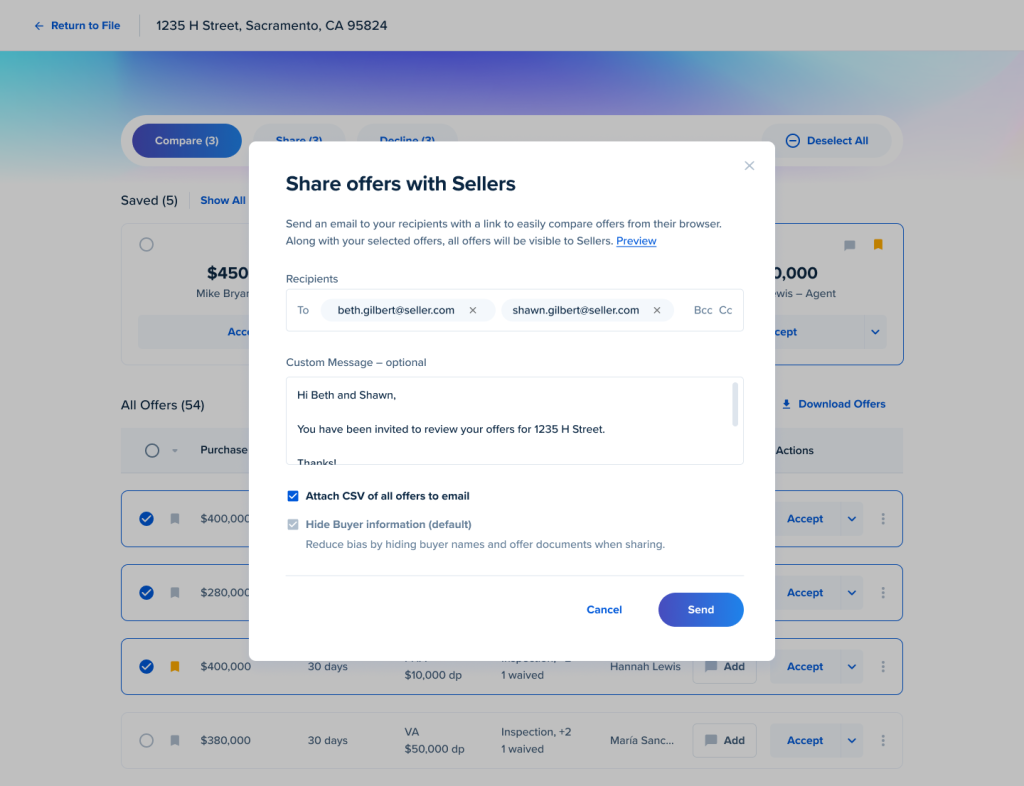
Hiding names narrows what a seller sees; the decision stays with the seller. The criteria, the instructions and the record of the seller’s reason remain the agent’s and the brokerage’s work.
FAQ
Can a seller choose an offer because of a buyer love letter?
A seller may weigh price, terms and timing, but may not refuse or fail to consider a bona fide offer because of a protected class (42 U.S.C. 3604, 24 CFR 100.60). Love letters often reveal those traits, so NAR advises agents not to deliver them, and advises a seller who insists on reading them to consult counsel and document the decision.
Are buyer love letters illegal?
The Fair Housing Act does not mention them; the risk is a seller choosing a buyer for a protected trait a letter reveals. Oregon banned them in 2021, but a federal court blocked the ban in 2022 and the legislature deleted it in 2024.
Does the Fair Housing Act apply to a homeowner selling their own house?
Usually. An owner of no more than three single-family houses who sells without a broker or agent, and without discriminatory advertising, is exempt from most of section 3604. The exemption ends once a broker or agent is used, and the ban on discriminatory statements applies either way (42 U.S.C. 3603(b)).
Can a listing agent tell buyers the terms of other offers?
A REALTOR may disclose that other offers exist only with the seller’s approval (Standard of Practice 1-15). Terms depend on state law: North Carolina requires the offering party’s express authority, and Wisconsin bars disclosing any terms of one buyer’s offer to another buyer.
What does Article 10 of the REALTOR Code of Ethics require?
It bars REALTORS from denying equal professional services, or joining any plan to discriminate, because of race, color, religion, sex, disability, familial status, national origin, sexual orientation or gender identity. Its Standards of Practice also bar steering, discriminatory statements and harassment on those grounds.
How long does a buyer have to file a fair housing complaint?
Under the Fair Housing Act, one year after the alleged practice to file with HUD, and two years to sue (42 U.S.C. 3610 and 3613). HUD’s state and local partner agencies handle about three-quarters of Fair Housing Act complaints.
See every offer on one page, compared on its terms, in SkySlope Offers.
Request a demo →Sources
- 42 U.S.C. 3602, definitions. www.govinfo.gov/content/pkg/USCODE-2024-title42/html/USCODE-2024-title42-chap45-subchapI-sec3602.htm
- 42 U.S.C. 3603, exemptions. www.govinfo.gov/content/pkg/USCODE-2024-title42/html/USCODE-2024-title42-chap45-subchapI-sec3603.htm
- 42 U.S.C. 3604, discrimination in the sale or rental of housing. www.govinfo.gov/content/pkg/USCODE-2024-title42/html/USCODE-2024-title42-chap45-subchapI-sec3604.htm
- 42 U.S.C. 3610, administrative enforcement. www.govinfo.gov/content/pkg/USCODE-2024-title42/html/USCODE-2024-title42-chap45-subchapI-sec3610.htm
- 42 U.S.C. 3613, enforcement by private persons. www.govinfo.gov/content/pkg/USCODE-2024-title42/html/USCODE-2024-title42-chap45-subchapI-sec3613.htm
- 24 CFR 100.60, unlawful refusal to sell. www.law.cornell.edu/cfr/text/24/100.60
- 24 CFR 100.75, discriminatory statements. www.law.cornell.edu/cfr/text/24/100.75
- California Government Code 12955. leginfo.legislature.ca.gov/faces/codes_displaySection.xhtml?lawCode=GOV§ionNum=12955
- New York Executive Law 296. www.nysenate.gov/legislation/laws/EXC/296
- Illinois Human Rights Act, 775 ILCS 5/3-102. www.ilga.gov/legislation/ilcs/fulltext.asp?DocName=077500050K3-102
- Florida Statutes 760.23. www.leg.state.fl.us/statutes/index.cfm?App_mode=Display_Statute&URL=0700-0799/0760/Sections/0760.23.html
- NAR, 2026 Code of Ethics and Standards of Practice. www.nar.realtor/about-nar/governing-documents/code-of-ethics/2026-code-of-ethics-standards-of-practice
- NAR, Code of Ethics and Arbitration Manual, Appendix IX: multiple offers. www.nar.realtor/code-of-ethics-and-arbitration-manual/part-4-appendix-ix-presenting-and-negotiating-multiple-offers
- NAR Fair Housing Corner, Love letters or liability letters? (2020). www.nar.realtor/fair-housing-corner/love-letters-or-liability-letters
- NAR Window to the Law, How to handle multiple offers (2020). www.nar.realtor/news/videos/window-to-the-law/how-to-handle-multiple-offers
- NAR Window to the Law, Best practices for buyer love letters (2021, updated 2022). www.nar.realtor/node/183698
- NAR, Oregon bans buyer love letters (2021). www.nar.realtor/news/real-estate-news/law-and-ethics/oregon-bans-buyer-love-letters
- NAR, settlement FAQs 50 and 75. www.nar.realtor/the-facts/nar-settlement-faqs
- Oregon HB 2550 (2021), enrolled. olis.oregonlegislature.gov/liz/2021R1/Downloads/MeasureDocument/HB2550/Enrolled
- Oregon Real Estate Agency, FAQs regarding HB 2550 (2021). www.oregon.gov/rea/newsroom/pages/2021_oren-j/faqs-regarding-hb-2550-the-love-letter-law.aspx
- Total Real Estate Group v. Strode, opinion and order (D. Or., March 3, 2022). www.govinfo.gov/content/pkg/USCOURTS-ord-3_21-cv-01677/pdf/USCOURTS-ord-3_21-cv-01677-0.pdf
- Oregon Real Estate Agency, court stops enforcement of the love letter law (2022). www.oregon.gov/rea/newsroom/pages/2022_oren-j/us-district-court-stops-enforcement-of-love-letter-law.aspx
- Oregon Laws 2024, chapter 102 (HB 4063). www.oregonlegislature.gov/bills_laws/lawsstatutes/2024orLaw0102.pdf
- Oregon Real Estate Agency, 2024 legislative recap. www.oregon.gov/rea/newsroom/pages/2024-oren-j/2024-legislative-recap.aspx
- Oregon Revised Statutes 696.805 (2025 edition). www.oregonlegislature.gov/bills_laws/ors/ors696.html
- North Carolina 21 NCAC 58A .0115. http://reports.oah.state.nc.us/ncac/title%2021%20-%20occupational%20licensing%20boards%20and%20commissions/chapter%2058%20-%20real%20estate%20commission/subchapter%20a/21%20ncac%2058a%20.0115.pdf
- Wisconsin Administrative Code chapter REEB 24. docs.legis.wisconsin.gov/code/admin_code/reeb/24.pdf
- HUD, FHEO Annual Report on Fair Housing, FY 2022. www.hud.gov/sites/dfiles/FHEO/documents/FHEO%20Annual%20Report%20FY%202022.pdf
- HUD, 2026 Congressional Justification, Fair Housing Activities. www.hud.gov/sites/dfiles/CFO/documents/2026_CJ_Program_FHEO.pdf
- HUD, news release 10-174 (2010). archives.hud.gov/news/2010/pr10-174.cfm
- HUD, news release 13-051B (2013). archives.hud.gov/news/2013/pr13-051b.cfm
- SkySlope Offers. skyslope.com/products-services/offers/

