What is real estate accounting software for brokerages?
Real estate accounting software for a brokerage is built around three things a general ledger does not track on its own: the commission plan that divides each closing between agent, team and firm; client money held in a trust account, which must be kept separate from operating cash; and monthly agent billing. At year end it provides reconciled trust balances and the figures needed for each agent’s 1099.
SkySlope Books is the accounting product in the SkySlope Suite. It shares data with SkySlope’s transaction management, so the closing that triggers a commission is the same record the accounting starts from.

Key takeaways
- “Real estate accounting” can mean brokerage, property management or investor accounting. This guide covers brokerages.
- Trust accounting is a major focus of regulator audits. Reconcile the bank statement, the trust journal and the client ledgers every month.
- The 1099-NEC threshold rose from $600 to $2,000 for payments made after December 31, 2025.
- A brokerage with 10 or more information returns in a year must file them electronically.
- A general ledger such as QuickBooks can stay in place for your accountant. It is not built to calculate commissions.
Three kinds of real estate accounting
Searches for real estate accounting software return three kinds of product, because three kinds of business use the phrase. They share some terms, such as trust accounts and 1099s, but the work is different.
Brokerage accounting
A firm that employs or contracts agents
- Commission splits, caps, team overrides, royalties
- Earnest money held in trust
- Monthly agent fees and invoices
- 1099-NEC for every agent
- Production and company-dollar reporting
Property management accounting
A firm managing rentals for owners
- Rent rolls and tenant ledgers
- Security deposits held in trust
- Owner statements and distributions
- Maintenance and vendor bills
- 1099s to owners and vendors
Investor bookkeeping
Someone who owns property
- Income and expense by property
- Depreciation
- Mortgage interest and escrow
- Schedule E tax reporting
- Portfolio returns
A brokerage that also manages rentals needs both of the first two, which are often separate products.
What brokerage accounting has to handle
Brokerage accounting covers five jobs. The first two are operational and are covered in our guide to real estate back office software. This guide focuses on the other three.
- Calculate commissions: apply each agent’s plan to each closing, including royalty, split, cap, team override and fees.
- Pay and bill agents: send payouts, run recurring fees and invoice what agents owe.
- Hold client money correctly: keep trust and escrow accounts and reconcile them monthly.
- Report to the IRS: issue a 1099-NEC to every agent paid over the threshold and e-file when required.
- Keep the general ledger: record income, expenses and the company dollar in a form an accountant can close.
Trust accounting
What is trust accounting in real estate?
Trust accounting is how a broker holds other people’s money, mainly earnest money deposits, without treating it as the firm’s money. Two problems matter most. Commingling is mixing client funds with the firm’s funds. Conversion is using client funds for any purpose other than the one they were given for. State regulators check for both. In California, seven of the ten violations the Department of Real Estate lists as most common in broker audits concern trust funds.
California allows a broker to keep no more than $200 of their own money in a trust account, for bank charges, and requires earned commissions deposited there to be withdrawn within 25 days.10 CCR section 2835. Other states set their own limits, so check your regulator’s trust fund rules.
The monthly three-way reconciliation
California requires trust records to be reconciled at least once a month (10 CCR section 2831.2), and monthly reconciliation is good practice in every state. Three balances have to agree:
If the bank and the trust journal agree but the client ledgers do not add up to the same total, money has been posted to the wrong client. If the trust journal and the client ledgers agree but the bank does not, a deposit or disbursement has not cleared or was recorded incorrectly. Brokerage accounting software updates the client ledgers as transactions are posted, so the reconciliation can be run as a report.
What auditors cite most often
The California DRE publishes the violations it finds most often in broker audits. Seven of the ten concern trust money, and most are record-keeping failures rather than theft:
| Regulation | What the DRE finds | How to prevent it |
|---|---|---|
| 2831 Trust fund records | No columnar record of all trust funds, missing columns, wrong amounts or dates, or no daily running balance | A trust journal kept up to date as money is posted |
| 2831.1 Separate records | No ledger for each beneficiary or transaction, or electronic deposits that cannot be attributed | A client ledger opened with every file |
| 2831.2 Reconciliation | No monthly reconciliation of client ledgers to the trust journal and the bank | A three-way reconciliation report run every month |
| 2832 Deposit timing | Trust funds not deposited within three business days, or an account not titled as a trust account | Deposits recorded against the file when received |
| 2832.1 Shortage | Disbursements that leave the account short of what is owed to all owners | Ledger balances checked before money is paid out |
| 2834 Withdrawals | The broker is not a signatory, or unlicensed signers are not bonded | Signing authority set up and reviewed |
| 2835 Commingling | Trust money in the operating account, or more than $200 of broker funds in trust | Separate accounts and a broker-funds ledger |
The other three violations on the DRE’s list are license numbers missing from first-contact materials, unlicensed fictitious business names, and inadequate broker supervision. The DRE notes that supervision problems most often show up as the trust fund issues above.
A month-end close for a brokerage
- Post every earnest money deposit and disbursement to its client ledger.
- Reconcile the trust journal to the bank statement at the cut-off date.
- Reconcile the total of the client ledgers to the adjusted trust balance, and correct any difference.
- Confirm that no more than the allowed broker funds are in the trust account, and move earned commissions out.
- Run commission and agent-billing totals, then close the operating books.
- Keep the reconciliation record: account, date and the amount held for each client.
1099s for agents, and what changed in 2026
Do brokerages issue agents a 1099 or a W-2?
In most cases, a 1099-NEC. Under Internal Revenue Code section 3508, a licensed real estate agent is a statutory non-employee when substantially all of their pay depends on sales rather than hours worked, and a written agreement says they will not be treated as an employee for federal tax purposes. This is one reason the independent contractor agreement matters.
The threshold changed for 2026 payments
Threshold for issuing a 1099-NEC to an agent.
Raised by the 2025 budget law, the One Big Beautiful Bill Act.
The $2,000 threshold is adjusted for inflation each year.
Fewer agents will need a 1099 for 2026, for example agents who joined late in the year or earned little. The software has to apply the threshold for the year each payment was made: a payment made on December 30, 2025 still counts under the $600 threshold.
E-filing is required at 10 returns
Starting with tax year 2023 returns, the IRS requires electronic filing when a business has 10 or more information returns, counting every 1099 and W-2 together rather than each form type separately. A brokerage with ten agents reaches that number. SkySlope’s support library explains how to e-file 1099s through the IRS’s IRIS system.
Where a general ledger fits
Many brokerages keep a general ledger such as QuickBooks because their outside accountant works in it. The limits appear when the ledger is asked to do brokerage-specific work. It has no commission plan, no cap that resets on an agent’s anniversary, and no built-in way to treat an earnest money deposit as client money. Those are usually rebuilt with journal entries and spreadsheets, which become harder to maintain as the agent count grows.
A common setup is brokerage software that calculates, pays and tracks, sending its results to the ledger. SkySlope Books connects to QuickBooks through an API for this purpose.
How to evaluate brokerage accounting software
Ask each vendor these questions, and ask to see the answer on a real closing.
| What to check | Why it matters | Ask to see |
|---|---|---|
| Trust ledgers per client | The three-way reconciliation depends on client-level balances. | A month-end trust reconciliation report |
| Commission plans as profiles | Plans should be assigned to agents, not rebuilt for each deal. | A capped agent’s split changing mid-year |
| Payout from inside the tool | Calculating and paying should be one process. | A payout from closing to transfer |
| 1099s from tracked payments | The threshold and payment year have to be applied correctly. | A 1099 run for agents paid before and after December 31, 2025 |
| Transaction data that arrives automatically | Re-typing closings is a common source of accounting errors. | A closing that appears in accounting without being entered again |
| A clean export to your ledger | Your accountant may still use a general ledger. | The QuickBooks or general ledger sync |
How SkySlope Books handles it
SkySlope Books is built for brokerages. SkySlope’s product page describes it as automating commission disbursement, agent payouts and invoices; calculating splits, fees and royalties from customizable commission profiles; adjusting team caps in real time; and producing 1099 reports. Payouts can be sent as next-day transfers through FDIC-insured partner accounts.

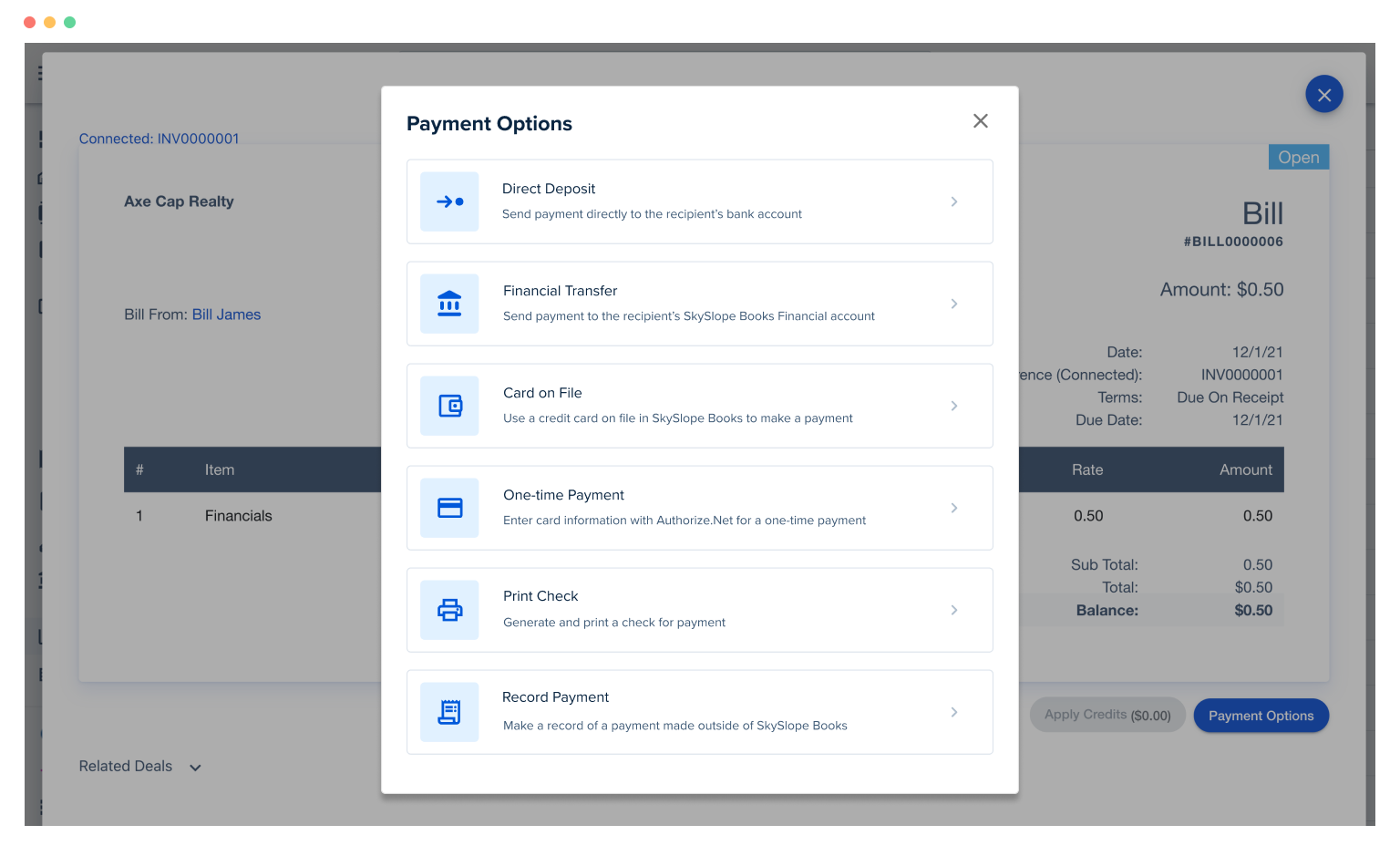
The SkySlope pricing page lists Books as an add-on to the SkySlope Suite, which starts at $340 per month. Books’ role in the rest of the brokerage’s operations is covered in real estate back office software, and the connection between closings and accounting in transaction management software.
FAQ
What is the best accounting software for a real estate brokerage?
Software built around commission plans, trust accounts and agent billing. A general ledger can record the results, but brokerage accounting software calculates them. For brokerages on SkySlope, SkySlope Books shares data with transaction management, so a closing is entered once.
Do real estate agents get a 1099-NEC or a W-2?
Most agents are independent contractors and receive a 1099-NEC. Under Internal Revenue Code section 3508, a licensed agent who is paid on sales output under a written agreement stating they are not an employee is a statutory non-employee.
What is the 1099-NEC threshold for 2026?
$2,000 for payments made after December 31, 2025, up from $600, with inflation indexing from 2027. Payments made during 2025 still used the $600 threshold.
Do I have to e-file 1099s?
Yes, if the brokerage has 10 or more information returns in total, counting 1099s and W-2s together. The IRS has required this since tax year 2023. Returns can be filed through the IRS Information Returns Intake System (IRIS).
What is a three-way reconciliation?
A monthly check that three balances agree: the trust account balance on the bank statement, the balance in the broker’s trust journal, and the total of the individual client ledgers. Any difference is investigated and corrected.
Can I use QuickBooks for a brokerage?
Many brokerages keep QuickBooks as the general ledger for their accountant. It does not include a commission engine or built-in tracking of client trust money, so those are handled by hand or in brokerage software that feeds the ledger. SkySlope Books connects to QuickBooks through an API.
See how a closing becomes a reconciled trust balance and a 1099 in SkySlope Books.
Request a demo →Sources
- California Code of Regulations, title 10, section 2835 (commingling). www.law.cornell.edu/regulations/california/10-CCR-2835
- California Code of Regulations, title 10, section 2831.2 (trust account reconciliation). www.law.cornell.edu/regulations/california/10-CCR-2831.2
- California DRE, Ten Most Common Violations Found in DRE Audits. dre.ca.gov/files/pdf/CommonViolationsFoundInAudits.pdf
- 26 U.S.C. section 3508, treatment of real estate agents. www.law.cornell.edu/uscode/text/26/3508
- Littler, tax bill changes 1099 reporting thresholds. www.littler.com/news-analysis/asap/tax-bill-changes-1099-reporting-thresholds
- IRS, e-file information returns with IRIS (10-return e-file requirement). www.irs.gov/filing/e-file-information-returns-with-iris
- SkySlope Books product page. skyslope.com/products-services/books/

