Are electronic signatures legally binding in real estate?
Yes. Under the federal ESIGN Act and the Uniform Electronic Transactions Act (UETA), adopted in 49 states and the District of Columbia, a signature or contract cannot be denied legal effect only because it is electronic. Listing agreements, buyer representation agreements, purchase agreements, counteroffers, addenda and disclosures are routinely signed electronically. The exceptions are at the edges of a transaction: a deed still needs notarization and recording, and ESIGN excludes wills and foreclosure notices on a primary residence.
DigiSign is SkySlope’s own e-signature product, integrated with SkySlope Forms and transaction management.

Key takeaways
- ESIGN (federal) and UETA (49 states and D.C.) make e-signatures enforceable. New York relies on its own Electronic Signatures and Records Act.
- The documents an agent prepares, including listings, buyer agreements, offers, counteroffers, addenda and disclosures, can be e-signed.
- Deeds are different because they must be notarized and recorded. California notaries cannot yet notarize remotely online.
- An e-signature holds up because of the record behind it: who signed, when, from where, and a sealed final document.
Is an electronic signature legally binding?
Two laws apply. The federal Electronic Signatures in Global and National Commerce Act (ESIGN), passed in 2000, says a signature, contract or record relating to a transaction in or affecting interstate commerce may not be denied legal effect solely because it is electronic. The Uniform Electronic Transactions Act (UETA) provides the same at state level and has been adopted in 49 states and the District of Columbia. New York has not adopted UETA; it relies on its own Electronic Signatures and Records Act, which has a similar effect.
For an electronic signature to be enforceable, four conditions are generally expected:
- Intent: the signer meant to sign.
- Consent: the parties agreed to do business electronically.
- Association: the signature is attached to, or logically associated with, the record being signed.
- Retention: the signed record can be kept and accurately reproduced.
Which real estate documents can be e-signed
The table below goes through the main documents in a residential transaction.
| Document | E-sign? | Notes |
|---|---|---|
| Listing agreement | Yes | Can be signed electronically under ESIGN and UETA. |
| Buyer representation agreement | Yes | Since August 17, 2024, NAR practice changes require a written agreement between a buyer and their REALTOR® before touring a home. It is commonly e-signed. |
| Purchase agreement and counteroffers | Yes | The most common e-signed documents in a transaction. |
| Addenda, amendments, contingency removals | Yes | Each version keeps its own signature record. |
| Seller disclosures and advisories | Yes | Delivery and acknowledgment can both be electronic. |
| Deed | Depends | Must be notarized and recorded. It can be completed electronically where the county accepts electronic recording and state law allows remote or in-person electronic notarization. |
| Lender closing package | Depends | The lender decides whether closing is fully electronic, hybrid (some wet signatures), or paper. |
| Foreclosure or default notice on a primary residence | No | Excluded from ESIGN’s general rule (15 U.S.C. section 7003). |
| Wills and testamentary trusts | No | Excluded from ESIGN and governed by state probate law. |
Yes Depends on county, lender or state notary rules Outside ESIGN’s general rule
Deeds, notaries and remote online notarization
Can you e-sign a deed?
A deed must be notarized and recorded with the county, which raises two questions. First, does the county accept electronically recorded documents? Many counties do, under state laws that often follow the Uniform Real Property Electronic Recording Act. Second, can the notarization be done electronically? That depends on state notary law.
Remote online notarization (RON) allows the signer to appear before a notary by audio-video link. Most states now allow it, each with its own rules on identity checks and session recording. California is an exception for now. Its law, SB 696, authorizes California notaries to perform remote online notarization once the Secretary of State completes the required technology project, or on January 1, 2030, whichever comes first.
Signing the purchase agreement electronically does not make the closing electronic. The lender and the title or escrow company decide how the loan documents and the deed are signed.
What makes an e-signature hold up
What makes an electronic signature enforceable if it is challenged?
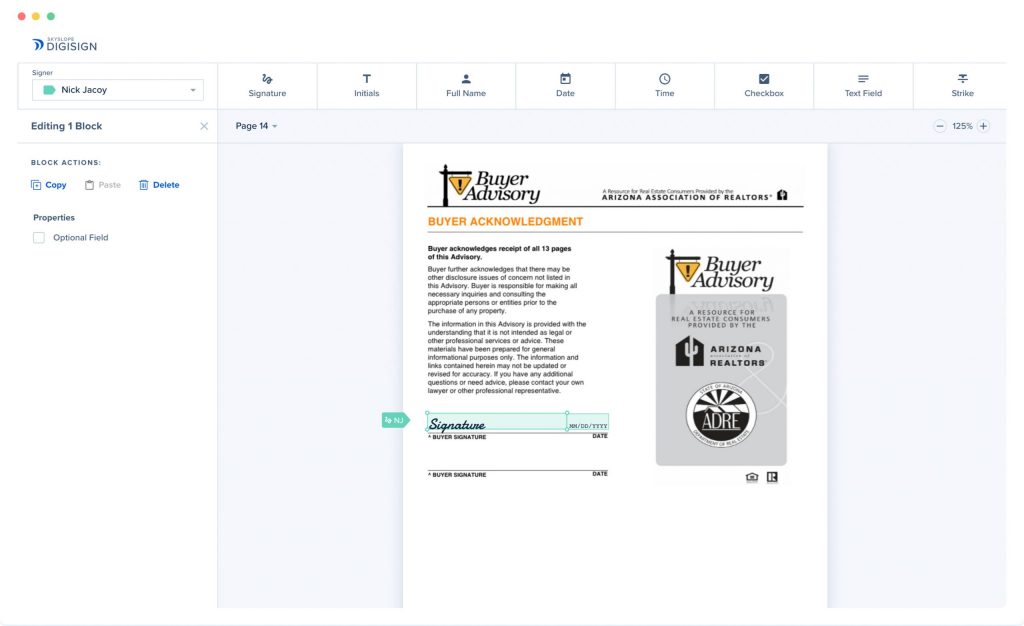
The record behind it. A defensible signature shows who signed, that they intended to sign, when each field was completed, and that the document has not changed since. On its DigiSign page, SkySlope describes a real estate e-signature as complying with ESIGN Act and UETA standards and capturing signer identity, IP address and timestamp.

How an envelope moves, step by step
- Agent
Prepare
Choose the property, add the forms and place the fields. In SkySlope Forms the property data is already on the form, and a saved template places fields where they were last time.
- Agent
Send
Each recipient receives a link and a note. Nothing is printed or downloaded.
- Client
Sign
The client signs, initials, dates and checks each field on any device, and the agent is notified in real time.
- System
File
The signed document returns to the transaction and is attached to its checklist item for the broker’s review.
What to check in an e-signature tool
| What to check | Why it matters | DigiSign |
|---|---|---|
| Unlimited envelopes | Per-envelope pricing adds a cost to every counteroffer. | Yes |
| Starts from the forms tool | A separate tool means exporting, uploading and placing fields again on every document. | Yes |
| Reusable field templates | Initials on a purchase agreement go in the same places every time. | Yes |
| Signing on a phone without an app | Requiring an app download makes signing harder for clients. | Yes |
| Real-time notifications | The agent knows as soon as a client signs. | Yes |
| Filing to the transaction | The signed copy should reach the broker’s review queue without being forwarded. | Yes |
| Signer details recorded | Identity, timestamp and IP address support the signature if it is challenged. | Yes |
E-signature does not verify wire instructions
Wire fraud usually targets the point where a buyer sends funds, and a signing tool cannot confirm that emailed wiring instructions are genuine. California’s standard forms include a Wire Fraud and Electronic Funds Transfer Advisory (WFA) for this reason. Advise clients to confirm wiring instructions by phone, using a number they found independently.
E-signature in SkySlope
DigiSign is SkySlope’s own e-signature product. Forms sends a packet to DigiSign in one step, and the signed documents return to the same transaction file for the broker’s review. The same workflow applies to California’s C.A.R. forms. SkySlope lists DigiSign at $6.25 per month, billed annually, with unlimited envelopes, and the SkySlope pricing page lists it as an add-on to the Suite. How signed documents move into compliance review is covered in real estate transaction management software.
FAQ
Are electronic signatures legal for real estate contracts?
Yes. The federal ESIGN Act and the Uniform Electronic Transactions Act, adopted in 49 states and the District of Columbia, give an electronic signature the same legal effect as a handwritten one. New York has not adopted UETA but reaches the same result under its Electronic Signatures and Records Act.
Can a deed be signed electronically?
Often, but it takes more than an e-signature. A deed must be notarized and recorded, so it depends on whether the county accepts electronic recording and whether state law allows the notarization to be done remotely online or electronically in person.
Is remote online notarization available in California?
Not yet from California notaries. Under SB 696, the remaining provisions take effect when the Secretary of State completes the required technology project, or on January 1, 2030, whichever comes first.
What is the difference between an electronic signature and a digital signature?
An electronic signature is any electronic mark that shows intent to sign. A digital signature is a cryptographic seal that shows a document has not changed since it was signed. Real estate signing tools generally use both.
Do clients need to download an app to sign?
Not with DigiSign. Clients can sign in a browser on any phone, tablet or computer, and the agent is notified in real time.
How much does DigiSign cost?
SkySlope lists DigiSign at $6.25 per month, billed annually, with all features and unlimited envelopes. On the SkySlope Suite pricing page it is listed as an add-on.
Send a purchase agreement through DigiSign and see it return to the transaction file.
Request a demo →Sources
- 15 U.S.C. section 7001, ESIGN Act general rule of validity. www.law.cornell.edu/uscode/text/15/7001
- 15 U.S.C. section 7003, ESIGN exceptions. www.law.cornell.edu/uscode/text/15/7003
- Uniform Law Commission, Uniform Electronic Transactions Act. www.uniformlaws.org/committees/community-home?CommunityKey=2c04b76c-2b7d-4399-977e-d5876ba7e034
- Uniform Law Commission, Real Property Electronic Recording Act. www.uniformlaws.org/committees/community-home?CommunityKey=643c99ad-6abf-4046-9da4-0a6367da00cc
- California Secretary of State, notary customer alerts (SB 696). www.sos.ca.gov/notary/customer-alerts
- NAR, consumer guide to written buyer agreements. www.nar.realtor/the-facts/consumer-guide-written-buyer-agreements
- C.A.R. list of standard forms (WFA). www.car.org/transactions/standard-forms/list-of-standard-forms
- SkySlope DigiSign product page. skyslope.com/products-services/digisign/

