What are C.A.R. forms?
C.A.R. forms are the standard real estate forms published by the California Association of REALTORS®. They include the California Residential Purchase Agreement (RPA), listing and buyer representation agreements, disclosures, advisories, counteroffers and contingency forms used on most California residential transactions. The forms are copyrighted, revised in scheduled releases, and usually filled in through a licensed forms platform.
SkySlope Forms has carried the C.A.R. Standard Forms library since March 2021. In February 2025, California Regional MLS (CRMLS) agreed to offer SkySlope Forms to its more than 100,000 users through the CRMLS dashboard.

Key takeaways
- The 23 forms below cover a typical California residential file. The timeline shows which stage each one belongs to.
- zipForm Standard, the desktop version, is available until December 31, 2026. C.A.R. expects to retire zipForm in 2027.
- Templates in the member-benefit version do not transfer to the replacement automatically. Rebuild them before the deadline.
- Contingency removal now uses two forms: CR-B (buyer) and CR-S (seller).
What C.A.R. forms are
The California Association of REALTORS® (C.A.R.) writes and maintains a library of standard forms so that California transactions use common, legally reviewed language. C.A.R. updates the library in scheduled releases, most recently in June 2026, so the version of a form matters as well as its name. Each form has a short code (RPA, SPQ, AVID) that agents use in conversation and on file checklists.
C.A.R. forms are licensed, and agents usually fill them in through a forms platform that carries the library.
Which form is used at each stage
Which C.A.R. forms are used at each stage of a California home sale?
The typical order on a residential file is shown below. Not every form appears on every file: COP is used only when the offer depends on another sale, FVAC only with FHA or VA financing, and ESD instead of TDS for exempt sellers.
Representation
RLABRBCADBefore touring or listing
Offer
RPAWFACOPFVACWriting the offer
Negotiation
SCOBCOCounteroffers
Disclosures
TDSESDSPQAVIDSBSARFRWhat the seller must disclose
Contingencies
RRCR-BCR-SNBPNSPInspections, repairs, deadlines
Closing
VPASWalk-through and escrow
If the transaction is cancelled, CC cancels the contract and directs the deposit.
Common C.A.R. forms by code
Form names follow C.A.R.’s list of standard forms.
| Code | C.A.R. form name | Stage | What it is for |
|---|---|---|---|
RLA | Residential Listing Agreement (Exclusive) | Representation | The seller’s contract with the listing brokerage. |
BRBC | Buyer Representation and Broker Compensation Agreement | Representation | The buyer’s agreement with their brokerage, including how the agent is paid. |
AD | Disclosure Regarding Real Estate Agency Relationships | Representation | Explains agency relationships before a representation agreement is signed. |
RPA | California Residential Purchase Agreement | Offer | The offer and, once accepted, the contract. |
WFA | Wire Fraud and Electronic Funds Transfer Advisory | Offer | Warns buyer and seller about fraudulent wiring instructions. |
COP | Contingency for Sale or Purchase of Property | Offer | Makes the offer contingent on selling or buying another property. |
FVAC | FHA/VA Amendatory Clause | Offer | Required language when the buyer is financing with an FHA or VA loan. |
SCO | Seller Counteroffer | Negotiation | The seller’s response changing the buyer’s terms. |
BCO | Buyer Counter Offer | Negotiation | The buyer’s response to a seller counteroffer. |
TDS | Real Estate Transfer Disclosure Statement | Disclosures | The seller’s statutory disclosure of the property’s condition. |
ESD | Exempt Seller Disclosure (formerly SSD) | Disclosures | Used by sellers who are exempt from the TDS. |
SPQ | Seller Property Questionnaire | Disclosures | Detailed seller answers that supplement the TDS. |
AVID | Agent Visual Inspection Disclosure | Disclosures | What the agent saw during a visual inspection. |
SBSA | Statewide Buyer and Seller Advisory | Disclosures | The advisory both sides acknowledge in a California transaction. |
RFR | Receipt for Reports | Disclosures | Confirms which reports the buyer received. |
RR | Request for Repair | Contingencies | The buyer’s repair requests after inspections. |
CR-B | Buyer’s Contingency Removal | Contingencies | The buyer removes contingencies, in whole or in part. |
CR-S | Seller’s Contingency Removal | Contingencies | The seller removes their own contingencies. |
NBP | Notice to Buyer to Perform | Contingencies | The seller’s notice when the buyer misses a deadline. |
NSP | Notice to Seller to Perform | Contingencies | The buyer’s notice when the seller misses a deadline. |
VP | Verification of Property Condition | Closing | The buyer’s final walk-through. |
AS | Seller’s Affidavit of Nonforeign Status | Closing | The seller’s tax status statement for escrow. |
CC | Cancellation of Contract, Release of Deposit & Joint Escrow Instructions | If the deal is cancelled | Cancels the contract and directs the deposit. |
The zipForm change and the December 31, 2026 date
C.A.R. provides zipForm to members as a free benefit. Its FAQ for members describes the following changes:
zipForm online and Transact by Lone Wolf both carry the current C.A.R. library.
The last day zipForm Standard, the desktop version, is available.
C.A.R. says zipForm “will likely be retired in 2027” and has not set a date.
- zipForm Standard (desktop) is available until December 31, 2026. After that, members must use the online version of zipForm or Transact to keep the current C.A.R. library.
- zipForm will “likely be retired in 2027”; C.A.R. has not set a date.
- Templates in the member benefit do not transfer automatically to Transact and need to be recreated. Active transactions and saved forms can be migrated.
- Brokerage accounts on zipForm for Brokers do not change until the broker admin starts the switch.
If your templates are in zipForm Standard, plan to rebuild them in your next platform before December 31, 2026.
Where California agents fill in C.A.R. forms
California agents can access the current C.A.R. library in three main ways:
| Route | How you get it | Notes |
|---|---|---|
| zipForm or Transact | C.A.R. member benefit | zipForm is being replaced by Transact by Lone Wolf; zipForm Standard ends December 31, 2026 |
| SkySlope Forms | Through your brokerage, or through CRMLS | C.A.R. library since March 2021; available in the CRMLS dashboard since February 2025 |
| Your brokerage’s platform | Whichever platform your broker licenses | Ask your broker which forms library and signature tool the firm uses |
Some MLSs give members direct access to SkySlope Forms from inside the MLS, including CRMLS through its dashboard and UtahRealEstate.com and OneKey MLS through single sign-on. Existing users sign in at the SkySlope Forms login. More California information is on the SkySlope California page.
Filling, signing and filing them in SkySlope
Create the fileAgent
Start a Forms file for the listing or purchase. Every form, signature and version is kept in it.
Import MLS dataSystem
Enter the MLS number and choose the listing. SkySlope fills in the property address, parcel number and list price on every form in the file.
Add forms or a templateAgent
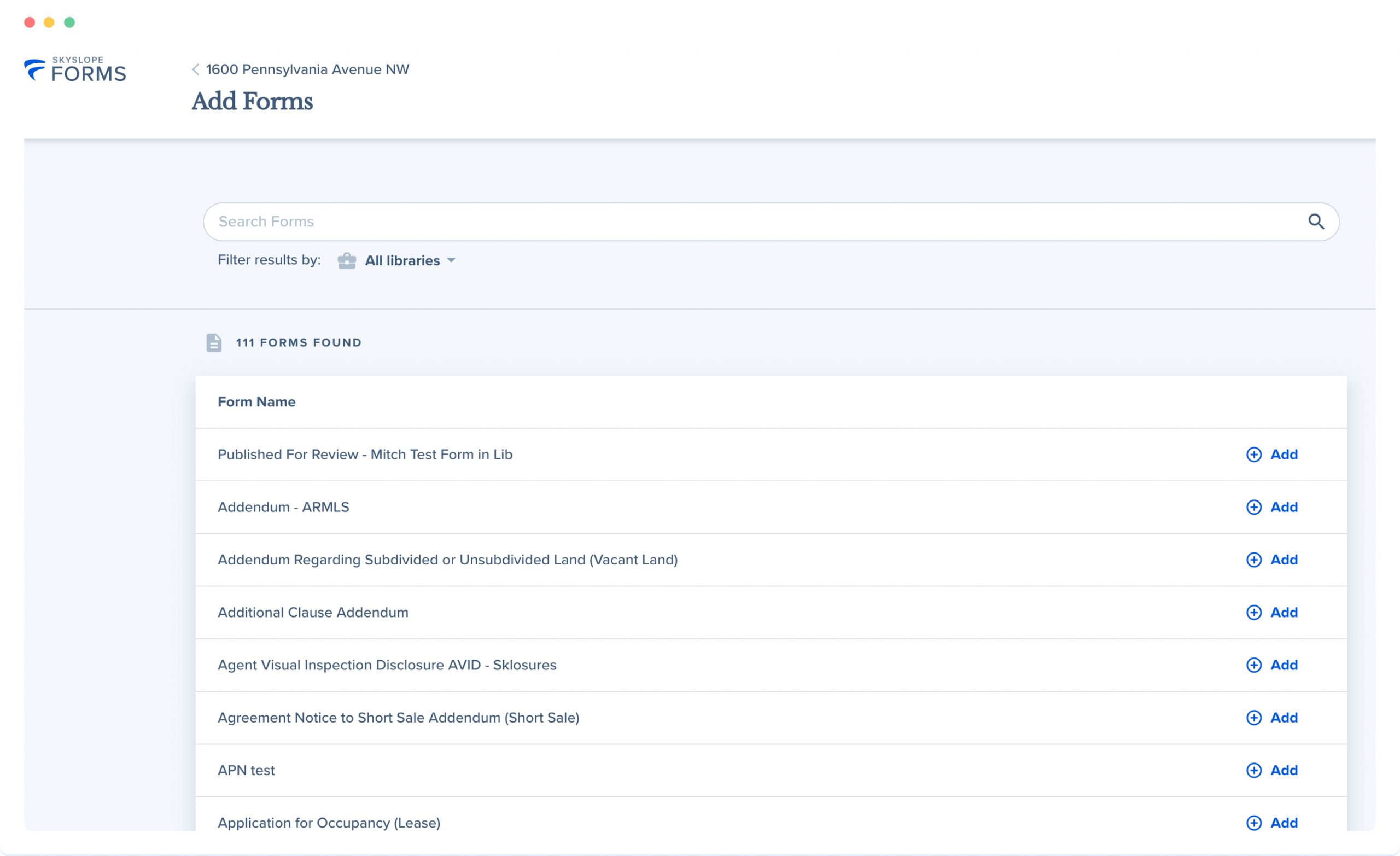
Add C.A.R. forms and your brokerage’s own documents from one searchable list, or apply a saved template.
Sign and fileClient
Send the packet to DigiSign. Signed forms return to the file and, for brokerages on SkySlope, to the transaction checklist.

Signatures are handled in DigiSign, SkySlope’s own e-signature tool. Which California documents can be signed electronically, and which still need a notary, is covered in electronic signatures in real estate.
Using the forms as a broker’s checklist
For a California brokerage, the same forms become the compliance checklist each file is reviewed against. A purchase-side checklist based on the forms above usually looks like this; the broker decides which items are required and which are conditional.
| Checklist item | C.A.R. form | Required when |
|---|---|---|
| Agency disclosure | AD | Every file |
| Buyer representation agreement | BRBC | Before touring |
| Purchase agreement, signed | RPA | Every file |
| Counteroffers, all versions | SCO / BCO | If countered |
| Wire fraud advisory | WFA | Every file |
| Transfer disclosure or exemption | TDS / ESD | Every file |
| Seller questionnaire | SPQ | Non-exempt sellers |
| Agent visual inspection | AVID | Every file |
| Statewide advisory | SBSA | Every file |
| Contingency removal | CR-B | Before contingencies expire |
| Final walk-through | VP | Before close |
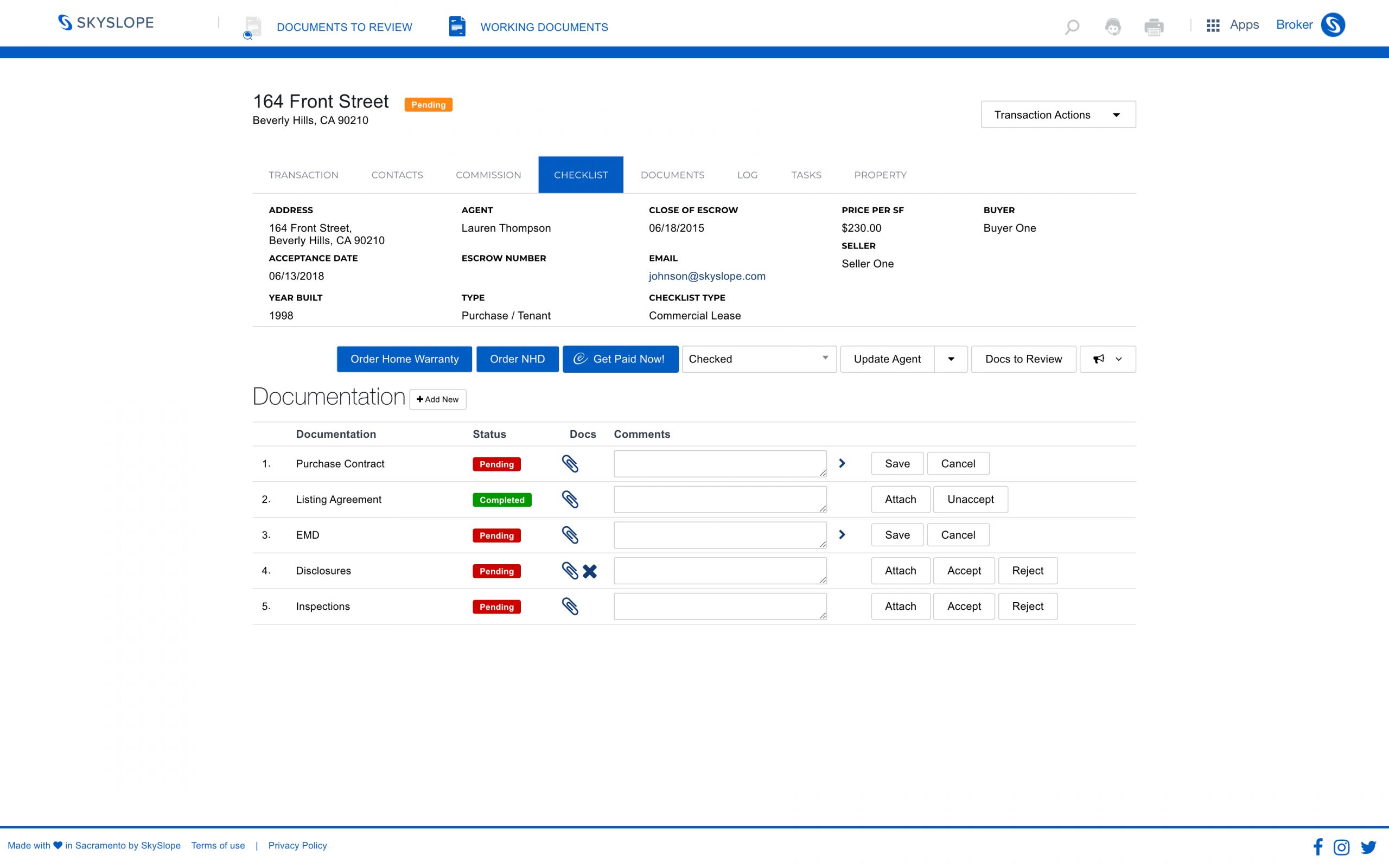
In SkySlope each item is a checklist line. The agent uploads the document, it is attached to its line, and the broker accepts or rejects it. That record is what a DRE audit reviews.
Preparing before December 31
What should California agents do before zipForm Standard ends?
- List your templates. Record every saved packet and clause set in zipForm Standard, since these do not transfer automatically.
- Check what your brokerage uses. If your broker already licenses a platform with the C.A.R. library, rebuild your templates there.
- Decide on active files. Choose which open transactions will finish where they are and which will move.
- Confirm your signature tool connects to your forms tool, so signed documents come back without re-uploading.
- Start early. Rebuilding templates in the last week of December, during active escrows, makes errors more likely.
Brokers moving a whole office should also read our guide to choosing transaction management software, since the forms decision and the compliance review decision are usually made together.
FAQ
What are C.A.R. forms?
The standard real estate forms published by the California Association of REALTORS®, including purchase agreements, listing and buyer representation agreements, disclosures, advisories, counteroffers and contingency forms used on most California residential transactions.
Where can I fill out C.A.R. forms?
Through a forms platform licensed to carry the C.A.R. library. C.A.R. members receive zipForm, which is being replaced by Transact by Lone Wolf, as a member benefit. SkySlope Forms also carries the library and is available through brokerages and through CRMLS.
Is zipForm Standard being discontinued?
Yes. C.A.R.’s FAQ says zipForm Standard, the desktop version, is available until December 31, 2026, and that zipForm will likely be retired in 2027.
Will my zipForm templates transfer automatically?
Not from the member-benefit version, according to C.A.R.’s FAQ; templates need to be recreated. Active transactions and saved forms can be migrated into Transact. Brokerage accounts on zipForm for Brokers change only when the broker admin starts the switch.
Are C.A.R. forms available in SkySlope?
Yes. SkySlope Forms has carried the C.A.R. Standard Forms library since March 2021, with MLS data sync, templates, brokerage libraries and DigiSign e-signature.
What replaced the CR contingency removal form?
C.A.R.’s current list has two forms: CR-B, Buyer’s Contingency Removal, and CR-S, Seller’s Contingency Removal.
See a C.A.R. purchase agreement go from MLS number to signed and filed in SkySlope.
Request a demo →Sources
- C.A.R., list of standard forms. www.car.org/transactions/standard-forms/list-of-standard-forms
- C.A.R., FAQ: zipForm vs. Transact by Lone Wolf. www.car.org/-/media/CAR/Documents/Transaction-Center/PDF/zipForm-Guides-2024/FAQs.pdf
- CRMLS, California Regional MLS to offer SkySlope Forms (February 25, 2025). go.crmls.org/california-regional-mls-to-offer-skyslope-forms-a-full-service-mls-integrated-digital-forms-platform-to-users/
- SkySlope Forms product page. skyslope.com/products-services/forms/

