How long do real estate agents stay with a brokerage?
The typical REALTOR® has been with their current firm for six years, and the typical member licensed as a sales agent for four, according to the National Association of REALTORS® 2026 Member Profile. In California, Texas and Florida, when an agent leaves, their listings and buyer agreements stay with the brokerage, because the client’s contract is with the broker, and commission on deals that close later is paid only by or through a broker.
In SkySlope, agent accounts are tied to the brokerage, and SkySlope Books calculates each agent’s pay from customizable commission profiles.

Key takeaways
- Median tenure with the current firm is six years for REALTORS®, nine for brokers and broker associates, and four for sales agents (NAR 2026 Member Profile).
- NAR does not ask agents why they left. Firms say departing licensees most often left the industry (36%) or moved to another company (34%).
- 14% of one-office firms name agent retention among their biggest challenges, against 45% of firms with four or more offices.
- In California, Texas and Florida the listing is the broker’s contract, and later commission is paid only by or through a broker.
- SkySlope files cannot move between brokerages, so departing agents download what they need before the account is deactivated.
How long agents stay with a brokerage
How long do real estate agents stay with a brokerage?
NAR’s Member Profile, from a March 2026 survey with 5,116 responses, reports how long each member had been with their present firm:
| Time with present firm | All REALTORS® | Licensed as broker or broker associate | Licensed as sales agent |
|---|---|---|---|
| 1 year or less | 28% | 18% | 35% |
| 2 years | 9% | 8% | 9% |
| 3 years | 5% | 3% | 6% |
| 4 years | 5% | 3% | 6% |
| 5 years | 5% | 6% | 5% |
| 6 to 11 years | 20% | 20% | 21% |
| 12 years or more | 29% | 42% | 19% |
| Median | 6 years | 9 years | 4 years |
NAR 2026 Member Profile, Exhibit 4-3, page 41. Last year’s survey also had a median of six years, with 23% at their firm a year or less.
The 28% at their firm a year or less includes people new to the business: 11% of members had a year or less of experience. Tenure lengthens with experience, from a median of one year at the firm for members with two years or less in real estate to 14 years for those with 16 or more. In an October 2026 analysis, NAR found that nearly a quarter of members with 6 to 10 years of experience had joined their firm within the last year, against 8% of those with 26 or more. In NAR’s words, “firm mobility is more common during the early and middle stages of a real estate career.”
Why agents leave, and where they go
Why do real estate agents leave their brokerage?
NAR does not ask agents why they left a firm. Its 2025 Profile of Real Estate Firms asks the other side: 4,672 firm executives said where licensees went after leaving in 2024. Firms could give several answers.
| Where licensees went after leaving | Share of firms |
|---|---|
| Left the real estate industry | 36% |
| Moved to another real estate company | 34% |
| Retired | 27% |
| Relocated and left real estate | 9% |
| Relocated and stayed in real estate | 7% |
| Opened an independent firm | 6% |
NAR 2025 Profile of Real Estate Firms, page 15. Also: died 9%, other 28%.
Only the moves to another company, and the 6% who open their own firm, are losses to a competitor. The share of firms reporting moves to another company was higher at team and hybrid firms (47% each) and virtual firms (40%), NAR found.
Retention pressure rises with size. 18% of firms named agent retention among their biggest challenges for the next two years: 14% of one-office firms, 28% of two-office firms, 44% of three-office firms and 45% of firms with four or more. Replacing agents who leave was a reason to recruit for 37% of firms, and 56% of firms with four or more offices.
In 2023 SkySlope surveyed 82 SkySlope agents on what they look for when selecting a brokerage and what influences them to leave one. Agents choosing a brokerage most valued reputation and culture, then technology and online tools; “support from others” led the additional factors; and agents already established at a brokerage ranked commission structure and fees first. It is a small sample of one company’s users, best read as a prompt for your own exit interviews.
How to calculate your agent retention rate
How do you calculate agent retention rate?
- Retention rate = agents at the start of the period who are still with you at the end, divided by agents at the start, times 100.
- Turnover rate = agents who left during the period, divided by agents at the start, times 100.
Agents who joined during the period are left out, so recruiting cannot hide departures. The Bureau of Labor Statistics computes separation rates for payroll jobs on the same pattern: separations divided by employment, times 100. An example: a brokerage starts the year with 40 agents; six leave and nine join, so it ends with 43. Retention is 34 of 40, or 85%, and turnover 15%, although headcount grew.
Record where each agent went, in NAR’s categories, so moves to a competitor are counted apart from retirements. Measure the share of last year’s closed transaction sides that came from agents who stayed, since agents’ production varies widely. Neither NAR report publishes a retention rate to compare against.
When an agent leaves: who decides what
State license law sets the floor: whose contract the listing is, who may pay the agent and how long the file is kept. The brokerage’s agreement with the agent fills in the rest, including the split on deals that close after the agent has gone.
Listings, pending deals and commission in California, Texas and Florida
Who owns the listing when an agent leaves a brokerage?
The broker, in all three states. TREC puts it plainly: listing agreements “are private contracts between the property owner and the real estate broker, not the sales agent,” and a buyer under a buyer agreement “would still be represented by the sales agent’s previous broker.” An agent can ask the broker to release a client; TREC says it cannot require a broker to do so.
| California | Texas | Florida | |
|---|---|---|---|
| Whose contract is the listing? | A listing agreement is “a written contract between a seller of real property … and a real estate broker” (Bus. and Prof. Code 10018.14) | Listings “must be solicited and accepted in a broker’s name” (22 TAC 535.2) | An associate acts “under the direction, control, or management” of the broker and collects money only “in the name of the employer” (475.01; 475.42(1)(d)) |
| Who pays commission on deals that close later? | The former broker sends it through the salesperson’s new broker, or pays directly if there is none (Bus. and Prof. Code 10137; DRE) | The current sponsor, or the broker who sponsored the agent when it was earned (Occ. Code 1101.651) | Claims lie only against the broker who employed the associate when the work was done (475.42(1)(d)); that broker can likely pay it under their agreement (Florida Realtors) |
| How long the broker keeps the file | Three years (Bus. and Prof. Code 10148) | Four years (22 TAC 535.2) | Five years (Fla. Stat. 475.5015) |
Read at each state’s statutes and regulator on November 3, 2026.
No regulator decides how a commission is divided after an agent leaves. TREC says it “does not determine what constitutes ‘procuring cause’ or who is entitled to a commission.” That is a term of the brokerage’s agreement with the agent, and California requires every broker to have a dated, signed, written agreement with each salesperson covering supervision, duties and compensation (Regulation 2726). Florida Realtors’ form independent contractor agreement is one model: after termination, the broker pays “any amount earned before termination less amounts owed to Broker and amounts Broker must pay another licensee to complete pending transactions.”
For REALTORS®, Standard of Practice 16-20 adds that, “prior to or after their relationship with their current firm is terminated,” they “shall not induce clients of their current firm to cancel exclusive contractual agreements” with the firm. It also lets a broker agree with its agents in advance on assigning those agreements.
Moving the license
How does an agent move their license to a new brokerage?
- California: the change of responsible broker is filed in the Department of Real Estate’s eLicensing system or on form RE 214, and the new broker must notify the DRE within five days (Regulation 2752). The DRE sends the previous broker a letter, and tells salespeople to give notice and follow their contracts when they leave. A salesperson with no broker affiliation cannot do licensed work.
- Texas: whoever ends the sponsorship notifies the other party and TREC immediately, and the license goes inactive from the date TREC receives the termination. The new broker sponsors the agent in TREC’s REALM Portal. An inactive license holder may not do brokerage work.
- Florida: the license “shall cease to be in force” when a sales associate changes employer, and the licensee notifies the Florida Real Estate Commission within 10 days (Fla. Stat. 475.23). The form is DBPR RE 11, Change of Status, which the new employer signs; there is no fee. No one may work as a sales associate without a valid and current active license (475.42(1)(a)).
An offboarding checklist
- Read the agreement for its notice, post-departure commission and file terms, and get the departure date in writing.
- Update the license record by the state’s deadline.
- List every open item: listings, buyer agreements and pending deals. Assign each to another licensee and tell the client in writing.
- Settle the money: commission on pending deals under the agreement, fees owed and cap position, paid through the brokerage.
- Complete the files before access ends, and keep them for the state’s retention period.
- Close access to transaction management, forms, e-signature, email and the website roster.
- Report the year’s pay on Form 1099-NEC, box 1a, if commissions paid in 2026 reach $2,000; due January 31, or the next business day.
- Ask why, in the same categories every time. It is the only reason-for-leaving data you will have.
Retention periods in other states are in our guide to brokerage compliance.
What brokers can change
None of these levers comes with a benchmark worth trusting, so measure your own retention before and after a change.
- Commission plans. Put the plan in writing, including what happens on departure, and show each agent how every closing was calculated. Our guides to back office software and brokerage accounting software cover running plans, caps and payouts.
- Support. Errors and omissions insurance is the benefit members most often get from their firm (44%), and 40% pay for it themselves.
- Technology. Firms most often provide or encourage electronic contracts and forms (73%), e-signature (70%) and the MLS (65%); 36% provide transaction management. Keeping up with technology is a top challenge for 34% of firms.
- Training. 71% of firms encourage certifications and designations, and 61% encourage additional training classes.
Recruiting, the other half of headcount, is covered in our guide to how brokerages attract top agents.
Agent offboarding and commission plans in SkySlope
SkySlope’s help center sets out what happens when an agent leaves a brokerage on SkySlope:
- Accounts are tied to the brokerage. Once the brokerage deactivates an agent, they lose access to their listing and transaction files and connected Forms and DigiSign accounts.
- Deactivation is done by an office manager, admin or broker with the right permissions, from Manage Agents in the Admin section.
- Files stay put. Listing and transaction files cannot be transferred from one brokerage to another, even when both use SkySlope, so agents download what they need first. To reuse their email address at a new SkySlope brokerage, the old account must be deactivated.
- Forms and DigiSign remain available through a personal SkySlope Forms subscription, which includes DigiSign.
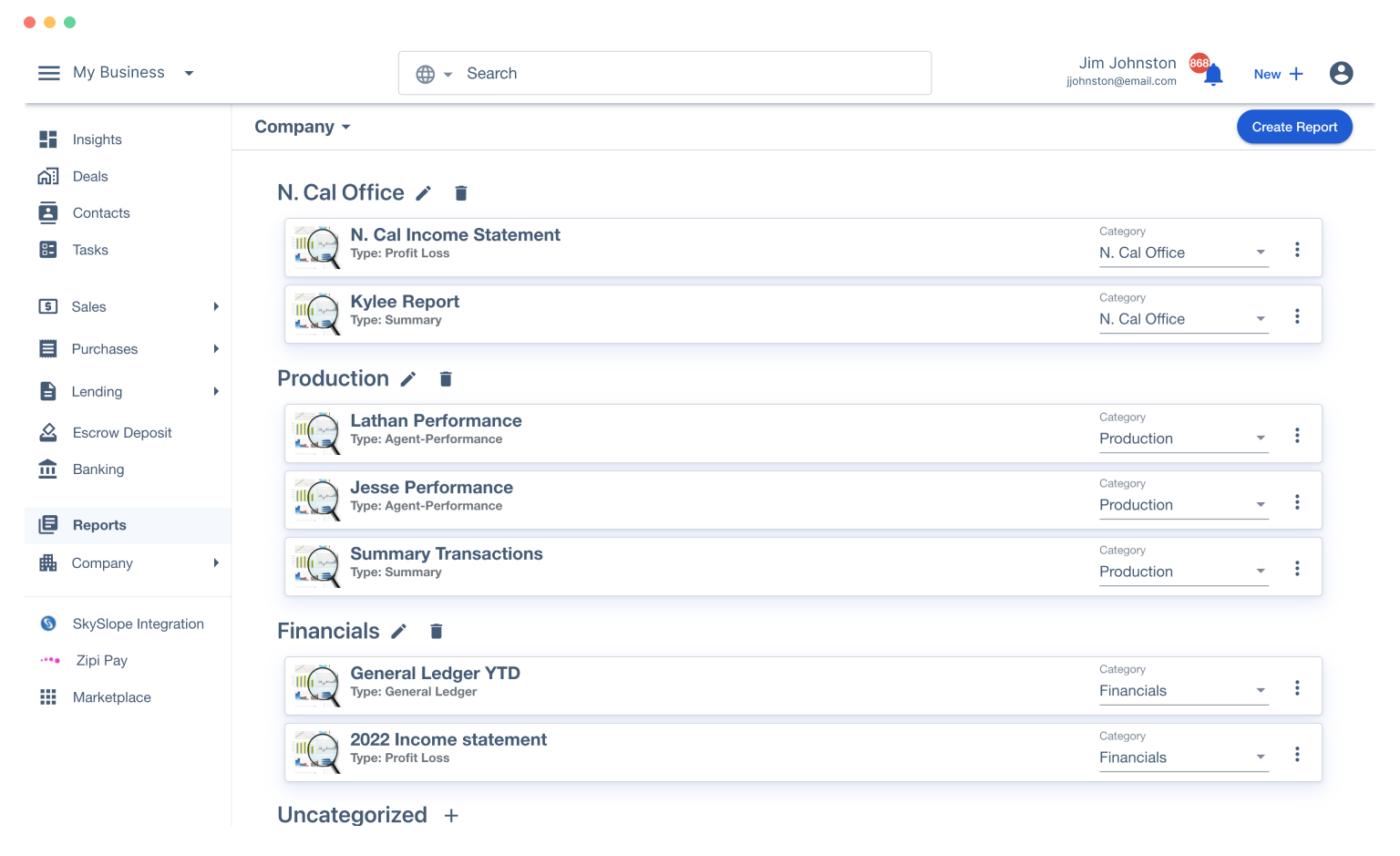
SkySlope Books calculates splits, fees and royalties with custom rules, automates team structures through customizable commission profiles, adjusts team caps in real time and has a cap report showing how close each agent is to their cap. Brokerages can email agents invoice statements, and Books has 1099 reports and dashboards for agent, team and office performance. Deal data from SkySlope can sync into Books automatically.
FAQ
How long do real estate agents stay with one brokerage?
The typical REALTOR® has been with their current firm for six years, according to NAR’s 2026 Member Profile. The median is nine years for members licensed as brokers and four for sales agents, and 35% of sales agents had been with their firm a year or less.
Why do real estate agents leave their brokerage?
NAR does not ask agents. It asks firms where departing licensees went: in its 2025 Profile of Real Estate Firms, 36% of firms said licensees left the industry, 34% said they moved to another company and 27% said they retired. In SkySlope’s 2023 survey of 82 SkySlope agents, established agents ranked commission structure and fees as what they value most.
Who owns the listing when an agent leaves a brokerage?
The broker. TREC says listing agreements “are private contracts between the property owner and the real estate broker, not the sales agent,” and buyer agreements work the same way. A client who wants to follow the agent asks the broker for a release.
Does an agent get paid on pending deals after leaving?
If their agreement with the broker says so, and only through a broker. Texas lets the broker who sponsored the agent when the commission was earned pay it; Florida limits a sales associate’s claims to the broker who employed them at the time. TREC says it does not decide who is entitled to a commission.
How do you calculate agent retention rate?
Divide the number of agents who were with you at the start of a period and are still there at the end by the number you started with, and multiply by 100. Agents who joined during the period do not count. Starting with 40 agents and keeping 34 gives 85%.
Can a departing agent take their clients with them?
Not the contracts, which stay with the brokerage until they end or the broker releases the client. REALTORS® are also bound by Standard of Practice 16-20: before or after leaving, they may not induce the firm’s clients to cancel exclusive agreements with the firm.
See commission plans, payouts and agent changes handled in SkySlope and Books.
Request a demo →Sources
- NAR, 2026 Member Profile (hosted by the Buffalo Niagara Association of REALTORS). www.bnar.org/downloads/NARmemberprofile2026.pdf
- NAR, 2025 Profile of Real Estate Firms. cms.nar.realtor/sites/default/files/2025-11/2025-profile-of-real-estate-firms-11-19-2025.pdf
- NAR, Agent movement and retention trends (October 16, 2026). www.nar.realtor/news/economists-outlook/agent-movement-and-retention-trends
- NAR, 2026 Code of Ethics and Standards of Practice. www.nar.realtor/about-nar/governing-documents/code-of-ethics/2026-code-of-ethics-standards-of-practice
- BLS, JOLTS Handbook of Methods: calculation. www.bls.gov/opub/hom/jlt/calculation.htm
- IRS, Instructions for Forms 1099-MISC and 1099-NEC (Rev. 12/2026). www.irs.gov/instructions/i1099mec
- California Business and Professions Code 10137. leginfo.legislature.ca.gov/faces/codes_displaySection.xhtml?lawCode=BPC§ionNum=10137
- California Business and Professions Code 10148. leginfo.legislature.ca.gov/faces/codes_displaySection.xhtml?lawCode=BPC§ionNum=10148
- California Business and Professions Code 10161.8. leginfo.legislature.ca.gov/faces/codes_displaySection.xhtml?lawCode=BPC§ionNum=10161.8
- California Business and Professions Code 10018.14. leginfo.legislature.ca.gov/faces/codes_displaySection.xhtml?lawCode=BPC§ionNum=10018.14
- California DRE, Real Estate Bulletin, Spring 2012 (commission earned by a formerly employed salesperson). www.dre.ca.gov/files/pdf/reb/rebspring_12.pdf
- California DRE, eLicensing FAQ: broker certification. secure.dre.ca.gov/faqs/faqs_use_elic_q16.htm
- California DRE, eLicensing FAQ: changing responsible broker. secure.dre.ca.gov/faqs/faqs_use_elic_q17.htm
- California Code of Regulations, title 10, section 2726. www.law.cornell.edu/regulations/california/10-CCR-2726
- California Code of Regulations, title 10, section 2752. www.law.cornell.edu/regulations/california/10-CCR-2752
- TREC, Do I get to take my listings with me?. www.trec.texas.gov/i-am-changing-sponsoring-brokers-do-i-get-take-my-listings-me
- TREC, Frequently asked questions. www.trec.texas.gov/public/frequently-asked-questions
- TREC rules, 22 TAC chapter 535. www.trec.texas.gov/agency-information/rules-and-laws/trec-rules
- Texas Occupations Code chapter 1101. statutes.capitol.texas.gov/Docs/OC/htm/OC.1101.htm
- TREC, How to change and accept sponsorship requests. www.trec.texas.gov/article/how-change-and-accept-sponsorship-requests
- Florida Statutes chapter 475 (475.01, 475.23, 475.42, 475.5015). www.leg.state.fl.us/statutes/index.cfm?App_mode=Display_Statute&URL=0400-0499/0475/0475.html
- Florida Realtors, What you need to know about Florida laws on real estate commissions. www.floridarealtors.org/law-ethics/library/compensation-commission
- Florida Realtors, My former broker reduced my commission (February 2024). www.floridarealtors.org/news-media/news-articles/2024/02/my-former-broker-reduced-my-commission
- Florida DBPR, form RE 11, Change of Status for Sales Associates (archived copy; the live DBPR site blocks scripts). web.archive.org/web/20260121014422/www2.myfloridalicense.com/re/documents/DBPR_RE_11_Change_of_Status_Associates.pdf
- SkySlope Support, What happens if I leave my brokerage?. support.skyslope.com/support/solutions/articles/156000366433-what-happens-if-i-leave-my-brokerage
- SkySlope Support, Deactivate a user in SkySlope. support.skyslope.com/support/solutions/articles/156000366274-deactivate-a-user-account
- SkySlope Books Support, Invoice statements. bookssupport.skyslope.com/support/solutions/articles/158000121912-invoice-statements-agent-contacts
- SkySlope Books. skyslope.com/products-services/books/

